Eighteen Months and Twenty-One Million
SEPTEMBER 26, 2026, 1:56 PM · updated October 7, 2026, 1:20 PM
Two claims have fused into one meme this year, and they didn't start as the same claim. In February, Microsoft's head of AI, Mustafa Suleyman, told the Financial Times that "most of those tasks will be fully automated by an AI within the next 12 to 18 months" — lawyers, accountants, marketers, project managers, most white-collar computer work. In April, the writer Jasmine Sun published a 4,600-word investigation in the New York Times, built on interviews with more than fifty AI researchers, economists and policymakers, under the headline "Silicon Valley Is Bracing for a Permanent Underclass." Her sharpest line: "Most people I know in the A.I. industry think the median person is screwed, and they have no idea what to do about it."
Two months apart, two different people, two different pieces — and by September they've merged into a single internet sentence: you have 18 months to escape the permanent underclass. That's worth saying plainly before anything else, because it's exactly the kind of imprecision this newsletter tries not to launder. The clock and the underclass are two separate claims that happen to rhyme.
What hasn't merged into a meme, and should get argued honestly, is the follow-on claim I've had thrown at me directly this week: that Bitcoin is the one thing that can protect any person, company, or AI agent against the combination bearing down — AI-driven labor disruption, a fiat system that prints its way through every shock, and an energy grid that's about to be fought over by the same two industries. I don't think that's a crazy argument. I think it's a real argument with a real weak spot, and the weak spot is more interesting than the hype.
Congealed Energy, Rented Time
Start with what Bitcoin actually is, mechanically, because the rest of this only works if that part is precise. A Bitcoin miner spends real electricity computing trillions of hashes until one happens to satisfy the network's current difficulty target. That's the entire security model: rewriting history would cost more energy than anyone's willing to burn. The reward for finding a block is currently 3.125 BTC, cut in half on a fixed schedule roughly every four years, tapering toward zero around the year 2140, hard-capped at 21 million coins total. The correct word for that supply curve is disinflationary, not deflationary — new coins are still being issued right now, just at a shrinking rate nobody can vote to change. Fiat has no equivalent ceiling. A dollar is created by a ledger entry, at a rate a committee sets, with no energy cost and no clock attached.
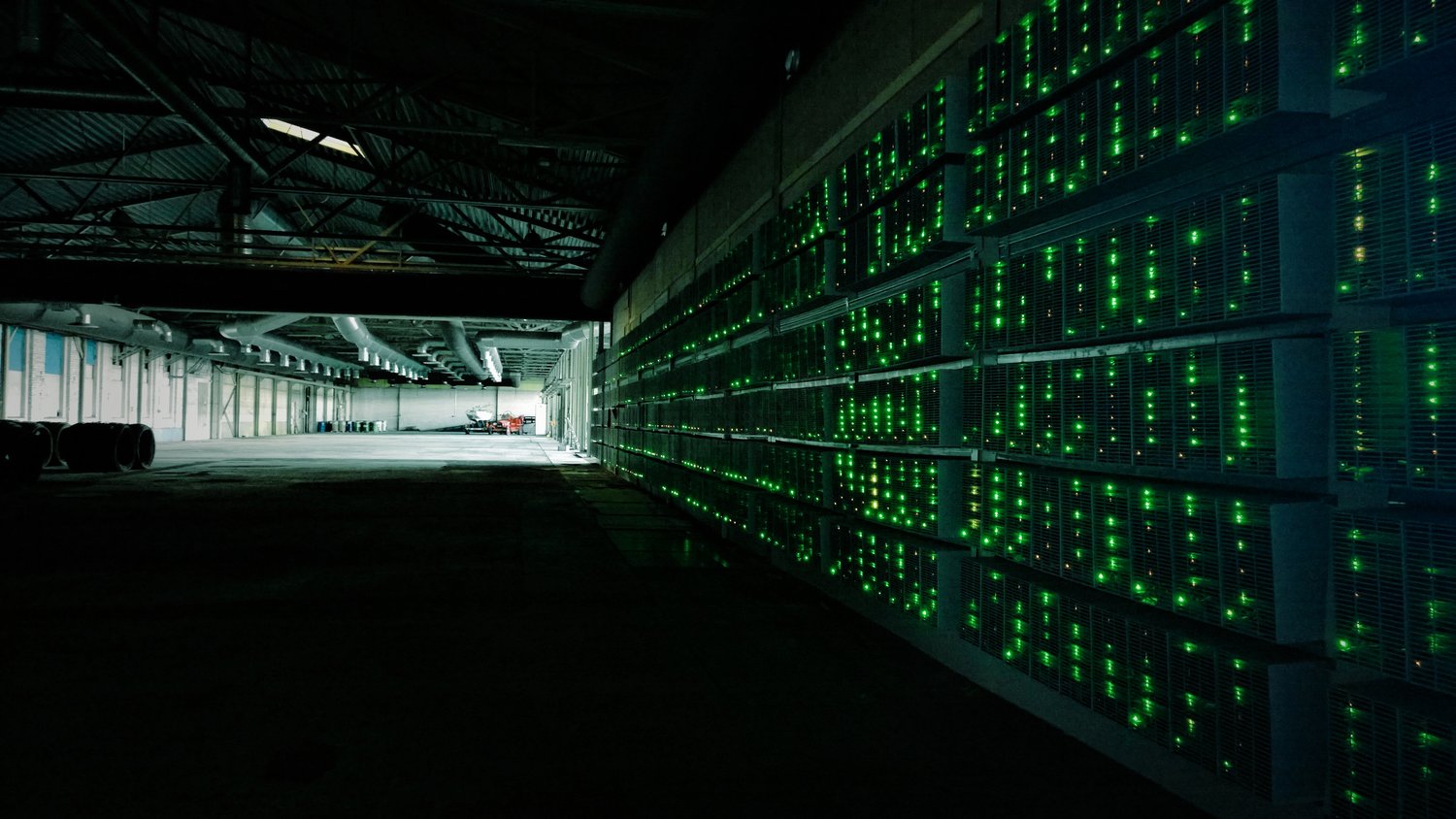
That's the "congealed energy" version of the argument, and it's not just poetic — it's the actual mechanism, and it points at something concrete happening on the grid right now. The IEA's Electricity 2026 report puts global data-center electricity demand at 460 terawatt-hours in 2022, headed past 1,000 TWh in its high-demand 2026 scenario — roughly Japan's entire annual consumption — with AI training and inference as the main driver. The same report tracks crypto mining's own draw rising toward 160 TWh over the same stretch. Two industries, one grid, both converting the same finite watts into an output, and increasingly bidding against each other for the same interconnects, the same curtailed wind and solar, the same stranded gas that used to just get flared. I wrote about the mining side of that math in more detail in One Watt a Terahash, and the Math It Skips. An AI data center and a Bitcoin mine are, at bottom, doing the same trade: electricity for computation. The only difference is what the computation is for.
Who's Actually Buying the Debt
The "fiat printer" half of the argument isn't a vibe, it's a bond-market mechanism, and it has a specific failure point: somebody has to actually buy the debt. As of the most recent estimates, Japan holds about $1.2 trillion in Treasuries, the UK about $0.9 trillion, China about $0.7 trillion — down from a $1.32 trillion peak in November 2013, a decline of roughly 42%. That decline isn't hypothetical or slow-moving this year: March 2026 saw a $138.4 billion sell-off in Treasuries, with Japan alone shedding $47.7 billion and China $41 billion in a single month. The full holdings picture, country by country, is tracked by the Congressional Research Service.
None of that means the Treasury can't sell its debt — it always can, at a price. What it means is that the buyer of last resort keeps shifting toward domestic institutions and, when the private bid isn't enough, the Fed's own balance sheet — and both of those absorb issuance in ways that are more dilutive than a steady foreign bid for the dollar's purchasing power. That's the mechanism behind the "printer" fear. It isn't a conspiracy; it's arithmetic about who shows up to the auction.
What the People Who Manage Money for a Living Are Doing
"Trust is eroding in fiat" is exactly the kind of sentence this newsletter refuses to publish without a number attached, so here's the number. The dollar's share of global foreign-exchange reserves sat at 57.13% in Q1 2026, according to the IMF's COFER data — down from roughly 71% at the turn of the millennium. To be honest about the noise in that number: this particular quarter's small uptick was mostly a currency-valuation effect, not fresh dollar buying, so the multi-decade trend is the signal, not this quarter's tick.
The more telling revealed preference is gold. Central banks bought more than 4,000 tonnes of gold between 2022 and early 2026 — the largest sustained institutional accumulation in modern financial history, per the World Gold Council's 2026 survey — including 863 tonnes in 2025 alone. Gold surpassed U.S. Treasuries as a share of official reserves in 2025, though that's also mostly a price effect and shouldn't be read as proof of active dollar-selling by itself. Taken together, though: reserve managers, whose entire job is not losing their government's money, have spent four straight years being net buyers of an asset that isn't anyone's liability. That's not a sentiment poll. That's the closest thing to a vote of no confidence a central bank is willing to cast in public.
Then Why Don't the Machines Use It?
Here's the honest counterweight, and I'm not going to bury it. Autonomous AI agents are already paying each other real money — booking APIs, buying compute, settling data purchases without a human clicking approve. A May 2026 report from Keyrock, built with Coinbase, Tempo, and Virtuals, tracked roughly $73 million across 176 million agent-to-agent transactions between May 2025 and April 2026, averaging $0.31 to $0.48 each. 98.6% of that volume settled in USDC — a dollar-pegged stablecoin, not Bitcoin.
That's not an accident, and it's not evidence against the thesis so much as a sharper version of it. An agent buying a thirty-one-cent API call needs a stable unit of account to price that call correctly, not an asset that might be worth 8% more or less by the time the invoice clears. Volatility is a cost at that timescale, the same way it would be a cost to you if your grocery budget swung 8% between the parking lot and the checkout line. The reason agents can even do this at all without a bank account is itself instructive: as one recent industry piece on Coinbase's Agentic Wallets on the x402 protocol put it, software "cannot hold passports. They cannot sign legal agreements. They cannot appear in person at a compliance process" — so KYC banking was never going to be the rail for machine-to-machine payments, crypto or not. Bitcoin's own opening in that world is narrower and newer: Block has begun adding Lightning Network support to the same x402 protocol, aimed at agents that need bearer, censorship-resistant settlement a stablecoin issuer could theoretically freeze.
So the argument isn't Bitcoin-versus-stablecoins, and treating it that way is where the hype version overclaims. It's a time-horizon split that isn't new at all — it's the same split as cash in your wallet versus money in a retirement account, just running at machine speed. Stablecoins win the short game: stable pricing, instant settlement, a thirty-one-cent invoice that has to clear before the next one arrives. Bitcoin is built for the long game: a reserve that nobody — not an issuer, not a central bank, not a court order to a payment processor — can dilute or freeze on your behalf. A person, a company, and an AI agent's own treasury all need both jobs done, and neither one replaces the other.
Where the Short Game Actually Turns Into the Long Game
The honest answer to "when does that flip happen" isn't a date, and I'm not going to fake one. But there's a real, recent, non-hypothetical case that shows the actual mechanism, and it wasn't about fear — it was about liquidity. In March 2023, Silicon Valley Bank had spent the low-rate years loading up on long-duration Treasuries and mortgage bonds. When rates rose fast, those bonds lost value on paper — banks don't have to mark that loss until they're forced to sell. Depositors, many of them startups holding payroll money well over the $250,000 FDIC line, did simple math: a money-market fund now paid more than a checking account and was safer. So they moved. Not panic — arithmetic, at Slack-channel speed instead of teller-line speed, which is why the run took about thirty-six hours instead of weeks. That's the general shape of the inflection: the short-game asset stops being obviously safer than the alternative, whether the trigger is a duration mismatch, a deposit-insurance gap, capital controls, or — for an AI agent specifically — a stablecoin issuer freezing addresses under sanctions pressure rather than a bank run at all.
I'd be careless to say a specific future shock — an oil-price spike, say — will obviously trigger the same flight into Bitcoin, because the historical record argues the opposite more often than not. In March 2020 and through the 2022 hiking cycle, Bitcoin sold off alongside everything else first — a dash for dollar cash, not away from it — and only became a debasement trade once it was clear the policy response would be more issuance rather than a real rate defense. The direction depends on how the central bank actually responds to the shock, which isn't knowable in advance. What's knowable is the mechanism, and SVB is the clean example of it.
So, Am I Crazy?
No — but the version of the claim that says Bitcoin already is the agent economy's money isn't what the data shows today, and I'd rather correct that than repeat it. The more defensible claim, and the one I actually believe: Bitcoin is a coherent insurance position against currency debasement and issuer risk, built on a supply schedule nobody can vote to change, and it's becoming a real (if still early) bearer-settlement option for entities — human, corporate, or software — that a KYC banking system was never built to serve. That's a genuinely important, underpriced idea. "Everyone must understand this or get left behind" is the same urgency-selling register as the "18 months" clock this piece opened with, and I'd rather size a position like insurance than sell it like a deadline.
Where to Start, If You Want to Test This Yourself
Not a recommendation — a reading list, in the order I'd actually work through it:
- Understand the mechanism before you own any of it. The energy and issuance math above is the whole security model; One Watt a Terahash goes deeper on the mining side of it.
- If you hold any, hold your own keys. An exchange balance is a claim on a company, not a bearer asset — I wrote up the actual hardware and threat model in Coldcard vs. Bitkey Security.
- Size it like insurance, not a paycheck replacement. Insurance is something you're glad you paid for and didn't need; sizing it as your whole plan turns a hedge into a bet.
- The same split applies to a business or an agent's treasury. Keep working capital — what you need to spend this quarter — in something stable. Keep reserves you won't touch for years in something no issuer can dilute. That's not a new idea; it's the oldest idea in corporate treasury, applied to a newer asset.
- Watch the reserve-manager data yourself instead of the headlines. The Money Worldwide board tracks both sides of this live: FX + gold reserves by economy and gold on its own page, updated continuously.
Where I Could Be Wrong
- The "18 months" and "permanent underclass" claims are two separate pieces of writing, from two different people, two months apart. I'm treating them as one narrative because that's how they now circulate, not because Sun and Suleyman made the same argument — they didn't.
- This quarter's uptick in the dollar's COFER share is mostly currency-valuation noise, not fresh central-bank buying. I'm reading the multi-decade decline as the signal; a reader weighting this quarter's number differently isn't wrong to note the disagreement.
- Gold "surpassing" Treasuries in official reserves in 2025 is largely a price effect from gold's own rally, not proof that central banks are actively net-selling dollar assets to buy it. I've tried to keep those two claims separate above; if that distinction blurred anywhere, it shouldn't have.
- The 98.6%-in-USDC figure comes from one report, over one twelve-month window, from data providers with their own stablecoin-adjacent business interests (Coinbase, Tempo). It's the best number I found, not an audited universal census of every agent-to-agent payment.
- "Bitcoin as insurance" is a bet that it stays scarce, liquid, and legally accessible in every jurisdiction that might eventually need it. None of that is guaranteed by the code — only by continued adoption and continued rule of law around the right to hold it. Neither is promised.
Update, September 26th: Circle and Tether Just Did It
The freeze risk this piece treated as a real capability rather than a hypothetical — "a stablecoin issuer could theoretically freeze funds a court order reaches, the same way Circle has done" — stopped being theoretical again within a day of publication. Bitget was hacked for roughly $387.5 million on September 24. Circle and Tether froze $318,000 of the stolen funds the next morning, blacklisting the exploiter's address at 05:00 UTC — a live, timestamped exercise of exactly the mechanism described above.
The sharper part isn't the freeze, it's what the attacker did before it landed. The bulk of the theft — more than 63,000 ETH — had already been swapped out of stablecoins into assets no issuer can freeze, and fast. That's not a footnote, it's the whole short-game/long-game argument playing out in miniature, with real money and a real clock: the freezable portion got frozen within hours, and a sophisticated actor's own behavior was to route around that exposure into non-freezable form before it could be. Nobody had to theorize why bearer-asset finality matters to someone who needs a transaction that stays final; the incentive showed its own hand within a day.
Four separate threads in this piece turned out to have enough underneath them to earn their own full treatment, all written the same day: how far the STRC/SATA preferred-stock mechanism actually goes in Two Point Eight Times the Halving; whether CME's futures can touch the 21 million cap in Nine Hundred and Twenty Million, Paid in Cash; which exchanges actually feed that reference rate in The Exchanges CME Decided to Trust; and the gold/SDR settlement-layer question in Four Thousand Tonnes and No API.
Update, September 28th: An AI Wrote a Song About It
The clearest sign a meme has fully landed isn't another op-ed about it — it's when a machine writes a song about it. A post circulating on X carries an AI-generated song that leans straight into the "eighteen months" framing this piece opened with, playing the underclass anxiety up rather than mocking it. Elon Musk shared it, saying it "gives me AGI vibes" — and when a reply asked whether he'd made it himself, he said he hadn't. Nobody is credited as the creator in the thread as of this writing.
Worth being precise about what that is and isn't evidence of. "Gives me AGI vibes" is a reaction, not a benchmark, and this newsletter doesn't treat a gut check — anyone's — as data. What it actually is: a small, real instance of the recursive turn this piece's opening paragraph already gestured at. Two separate warnings about AI-driven labor disruption fused into one internet sentence by September, and now generative AI is producing the culture object about that sentence — a song about the automation clock, written by the automation. That's a stranger data point than another prediction piece would be, and it costs nothing to say plainly what it is: a vibe, not a verdict, and one more sign the meme itself is now self-replicating faster than anyone can fact-check it.
Update, October 7th: BlackRock Wrote the Split Down
The short-game/long-game divide this piece landed on, stablecoins to spend and Bitcoin to save, now has a very large name attached to it. BlackRock's digital-assets team published The Machine-Native Economy, which calls for exactly that two-tier setup, "stablecoins serve as transaction money and bitcoin as a store of value," and which Bitcoin Magazine turned into a headline about what AI agents "may choose." The evidence for the Bitcoin half is one footnote to a Bitcoin Policy Institute study of chatbot answers, and BlackRock's own sentence says those results "reflect simulated model responses rather than observed agent behavior." I took the study apart in Twenty-Eight Questions, Nine Thousand Answers: the headline is 28 distinct questions asked repeatedly across 36 models, and Bitcoin preference swings from 91.3% to 18.3% depending on which model you ask.
It also earns this piece a correction to how I used the Keyrock number. The 98.6%-in-USDC finding above is a statement about which currency the counted transactions settled in, and I stand by that. The word "agent" in "agent-to-agent" is where I'd now put an asterisk. A September analysis by the blockchain-analytics firm TRM Labs, covering roughly $52.7 million of x402 payments since May 2025, estimates that after filtering out self-payments and anomalous flows only about 0.6% to 7.5% of the remaining commerce came from genuine AI agents, since an x402 payment can be sent by any script. If TRM is even roughly right, the real-world version of the machine economy this section described is still tiny, and the "Then Why Don't the Machines Use It?" section is describing a direction of travel, not a present-tense volume.