Two Point Eight Times the Halving
SEPTEMBER 26, 2026, 2:47 PM

This is the thread from Eighteen Months and Twenty-One Million that grew into its own story before the day was even over.
The Halving Isn't the Story Anymore
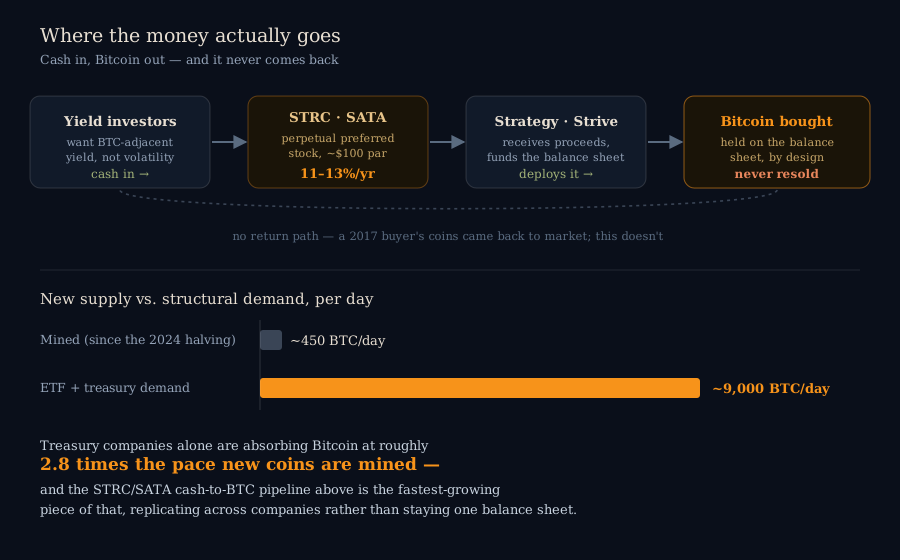
Since the April 2024 halving, Bitcoin's new supply has run at about 450 coins a day — roughly 164,250 a year, part of the same exactly-computable issuance schedule this site has walked through in full. That number used to matter enormously; the four-year halving cycle was the entire supply-side narrative for a decade. It's now a rounding error next to demand. Combined ETF and corporate treasury buying runs around 9,000 BTC a day — a roughly 20-to-1 imbalance against new issuance — and treasury companies tracked by BitcoinTreasuries.net have been accumulating BTC at about 2.8 times the pace new coins enter circulation through mining since that same halving. ETFs, corporate treasuries, and sovereigns together absorbed more Bitcoin than was mined in all of 2025. Several outlets are already calling this "the end of the four-year cycle" — that's not a fringe read at this point, it's a live 2026 narrative with real numbers under it.
The Instrument Doing the Absorbing
Inside that bigger story, one specific mechanism is growing faster than the rest: perpetual preferred stock, sold to yield-seeking investors, with every dollar raised earmarked to buy BTC that then never comes back to market. Strategy Inc. (the company still widely known as MicroStrategy) has launched five separate series in under 18 months — STRK (Jan 2025, ~$519M raised through July), STRF (Mar 2025, ~$219M), STRD (May 2025, ~$980M in a single offering), STRC (Jul 2025, $2.52B in its IPO alone), and STRE, a Euro-denominated sibling on the Luxembourg exchange. The company's aggregate preferred liquidation preference went from $10.0B in its Q1 2026 10-Q to $15.46B in Q2 — a 54.6% jump in a single quarter.
A second company is running the identical playbook. Strive Asset Management (ticker ASST) issues its own preferred, SATA — not a Strategy product, a separate company's instrument — and has been buying Bitcoin most weeks through 2026, taking holdings from roughly 13,300 in March to 26,355 by mid-September. In March 2026, Strive used SATA proceeds to buy $50 million of Strategy's own STRC. One BTC-treasury company's preferred stock is funding a purchase of a second company's preferred stock — a genuine replication-and-cross-investment dynamic, not just one balance sheet compounding on its own.
Correcting My Own Framing: It's Not a Cash-Flow Story
I initially flagged Strategy's negative operating cash flow (-$20.1M TTM from the actual software business) as a fragility in this mechanism. That was the wrong metric, and I want to say so plainly rather than let it stand. The software segment isn't what backs these dividends and never was intended to be — Strategy says outright that dividends come from capital raises and BTC sales. The real comparison is preferred liquidation preference against Bitcoin holdings value: roughly $15.46B in stacked claims against ~845,050 BTC, worth somewhere around $65-70B at prices BTC has traded near through September. That's a cushion of 4-to-1 or better, and the -$20M software number next to it is noise, not signal.
The more precise risk sits somewhere else, and it collapses into a single variable rather than several independent ones. The yield on this paper — 11 to 13%, three to four times what safe short-duration cash pays — exists specifically because the collateral is volatile and the stock is perpetual and equity-subordinated. That premium is compensation for the same risk the liquidation cushion measures, not a separate "will buyers keep showing up" question. If Bitcoin's price holds up, the spread stays attractive and demand stays structural — and it's already survived Bitcoin's 2025-2026 drawdowns without issuance stopping, which counts as real evidence, not just theory. If Bitcoin falls hard and stays down, the same spread would need to widen sharply or buyers would pause, which is what a real stress event in this mechanism would actually look like. One variable, not two.
The Trigger I Went Looking For, and What I Actually Found
There's a specific, checkable version of "this mechanism is accelerating": both instruments hitting daily dividend payments and trading within pennies of their $100 par value, which would turn them into something close to a savings-account substitute for a much larger pool of volatility-averse capital that would never touch spot BTC directly. I checked whether that trigger has already happened.
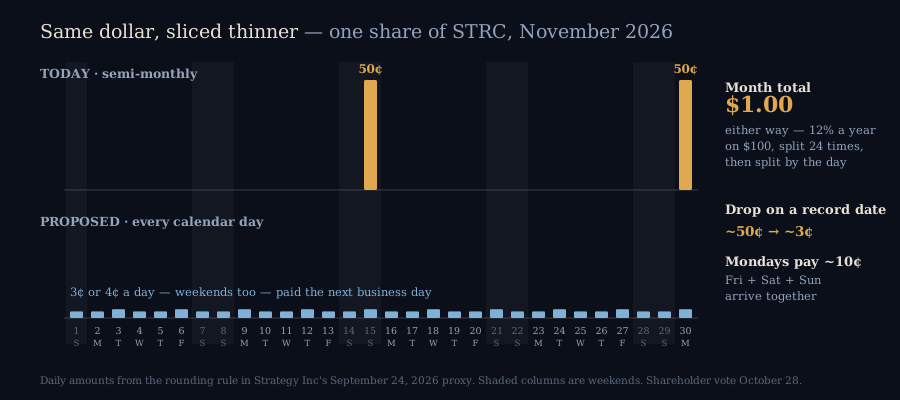
Half of it has. Strive made SATA the first U.S.-listed security to pay cash dividends every business day, starting June 16, 2026, and it holds near par via an explicit 18-month reserve of cash and marketable securities (including that $50.5M STRC stake) built specifically to defend the price. Strategy's STRC is chasing, not there yet — it moved from monthly to semi-monthly payments starting July 15, 2026, and its actual trading price has had real slack from par recently, sitting around $99.10 rather than pennies-tight as of the most recent data I have.
But I went further and tried to find the moment SATA's own daily-dividend switch actually moved the numbers, and the data doesn't hand me a clean story. Strive's weekly BTC purchases were noisy on both sides of June 16: a huge 2,500-BTC week happened before the switch (May 23-Jun 1), followed by two very quiet weeks right after it (17.76 BTC and 18 BTC in early July), and at least one week with zero purchases later in the quarter. SATA's own ATM share issuance tells a similar story — proceeds ramped from $1.2M to $326.3M mostly in April-May, before daily dividends existed, then only added about $19.4M more in the back half of June, straddling the switch itself. By September, Strive's SATA market value was reported approaching $1 billion — roughly triple its June 30 base — but I can't yet pin exactly which week that acceleration started in.
So the honest state of this piece, today: the mechanism is real, the daily-dividend design is real and already live on one of the two instruments, and the overall trend is unmistakably up. But "the trigger already fired on June 16" isn't something the data lets me claim yet. I'd rather tell you that plainly than round a messy series into a clean story.
Demand That Behaves Like a Supply Shock
One framing worth being precise about: this isn't a repeat of 2017. That was a classic demand shock — a flood of speculative buyers bidding up an unchanged, still-tradeable float, which is exactly why it was reversible and did reverse. What STRC and SATA do is structurally different: they convert capital that would otherwise sit in a money-market fund into BTC that is bought once and, by design, never resold. The proximate cause is still demand — someone has to buy the preferred stock — but the effect on the tradeable float is closer to what a genuine supply reduction would look like, because that BTC doesn't come back to the order book the way a 2017 speculator's coins eventually did. I'd call it demand that behaves like a supply shock rather than a textbook one, and I think that distinction matters more than which label wins.
Where I Could Be Wrong
- The 2.8x and 20-to-1 figures describe ETF-plus-treasury demand broadly. Preferred-stock financing specifically (STRC/SATA) is the fastest-growing slice of that, not the majority of it — about 30% of Strategy's own purchases were preferred-funded as of March 2026, up from a minority share a year earlier. Don't read this piece as claiming preferred stock alone explains the whole halving-irrelevance story.
- The June 16 SATA data genuinely doesn't confirm an immediate demand-shock timing. I've laid out the noisy series above rather than force a conclusion; a reader weighing it differently than "unresolved, watch the July-August gap" isn't wrong to.
- The 4-to-1 BTC-to-liquidation-preference cushion is a snapshot, not a guarantee — it moves with BTC's price day to day, and I haven't stress-tested what specific price level would actually compress it dangerously.
- "Demand that behaves like a supply shock" is my framing, not a term of art in finance — I think it's precise, but it's an argument, not a settled definition.