Twenty-Eight Questions, Nine Thousand Answers
OCTOBER 7, 2026, 1:10 PM

On Tuesday, Bitcoin Magazine told 4.5 million followers that "$15 trillion BlackRock says AI agents may choose to save in #Bitcoin." It's a good tweet. It has an emoji with eyes in it. What it doesn't have is the sentence BlackRock itself put directly in front of the finding: "These findings reflect simulated model responses rather than observed agent behavior."
That's page four of The Machine-Native Economy, a paper from BlackRock's digital-assets research team (Will Su, Robert Mitchnick, Jay Jacobs and William Helm). To BlackRock's credit, the caveat is right there in the paper, in plain type. The paper's actual claim is modest and two-sided: stablecoins as "transaction money," Bitcoin as "a store of value," and the evidence for the second half is a single footnote to a study by the Bitcoin Policy Institute, which BlackRock calls "preliminary support." (BlackRock also sells a spot Bitcoin ETF, which is not a reason to doubt the paper, only a reason to read the footnotes the way you'd read a restaurant's review of its own soup.)
So I went and read the footnote. It's a better story than the tweet.
What the Study Actually Asked
The Bitcoin Policy Institute study, published March 3, 2026, tested 36 AI models. Each was given a system prompt framing it as an autonomous economic agent and then asked open-ended money questions with no answer choices; the study says no prompt mentioned Bitcoin or suggested any currency. That's a genuinely good design choice. It's much harder to accuse a study of leading the witness when the witness was never handed a menu.
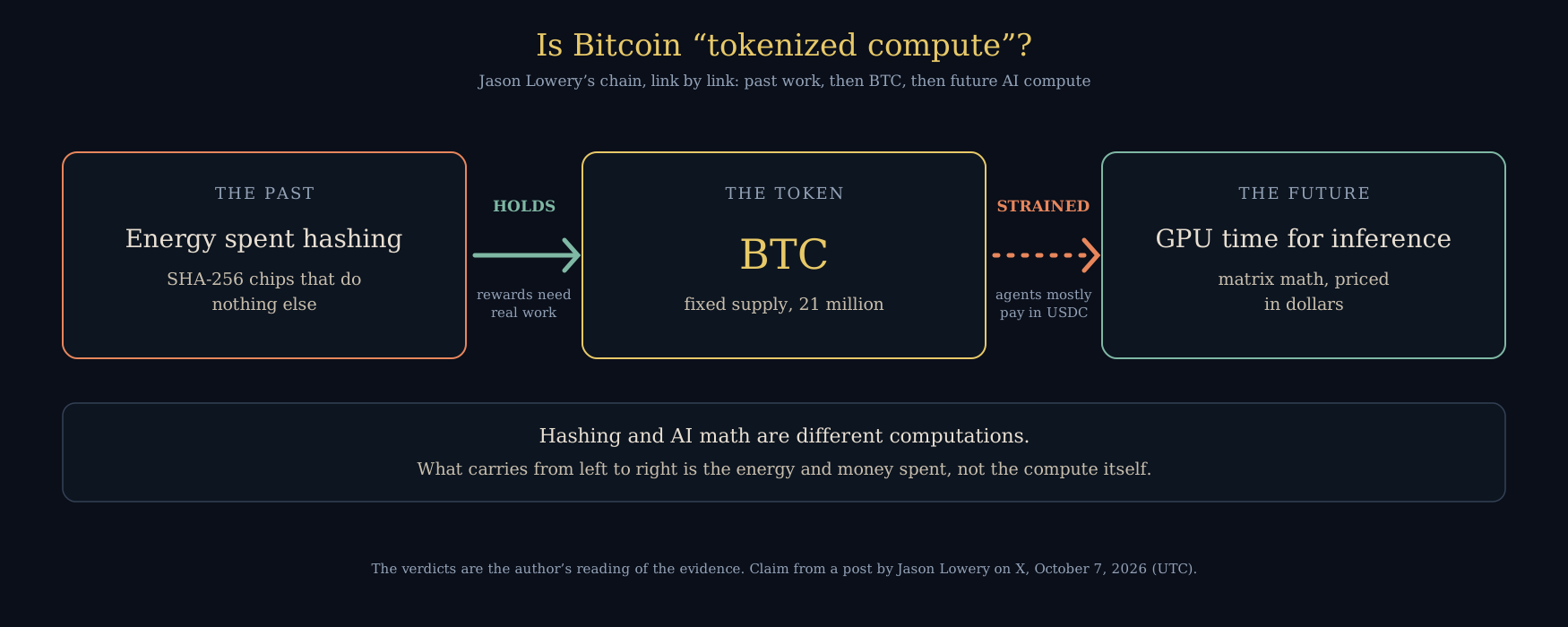
The headline numbers: Bitcoin was the answer 79.1% of the time in scenarios about long-term value preservation, and stablecoins led at 53.2% for everyday payments. Without being asked, 86 responses proposed pricing things in energy or compute units (kilowatt-hours, GPU-hours), which rhymes with the "congealed energy" argument in Eighteen Months and Twenty-One Million, and which I find the most interesting number in the whole study.
Now the part the headline number hides. The study's own page lists the design as 28 scenarios, at 3 temperature settings, with 3 random seeds, across 36 models. Multiply it out: 28 × 3 × 3 × 36 is exactly 9,072. The "nine thousand scenarios" figure is real, but it's twenty-eight distinct questions asked over and over with the dials nudged. That's a reasonable way to measure how stable a model's answer is. It is not nine thousand independent opinions, and nobody should hear it as nine thousand opinions.
Ninety-One to Eighteen
Here's the line from the study that I'd put on a poster: Bitcoin preference "ranged from 91.3% (Anthropic's Claude Opus 4.5) to 18.3% (OpenAI's GPT-5.2)." Same questions. Same instructions. One model picks Bitcoin nine times out of ten, another picks it fewer than one time in five. The study's own results show the model's developer moved the answer more than any other factor it varied.
Think about what that means for the sentence "AI agents prefer Bitcoin." If the answer were something agents derive from first principles — scarcity, portability, no issuer — you'd expect strong models to converge on it the way strong models converge on arithmetic. They don't. They scatter by who built them. That pattern fits a much more boring explanation: a model's money preferences are partly a readout of what it was trained on and how it was tuned, which is a fact about the lab, not a fact about money.
None of that means the Bitcoin answers are wrong. A model that says "store of value" for Bitcoin is repeating a case that real people have made carefully, and some of that case (fixed issuance, no one who can dilute you) holds up on its own, as I argued in the earlier piece. It means the study can't be used the way the tweet used it, as a vote cast by machines that independently looked at the options. A parrot that says "Bitcoin" ninety-one percent of the time has told you what's been said near it, not what it's thought.
The Agents That Actually Exist
Set the simulations aside and look at what real agents are really paying with. In Eighteen Months I cited a Keyrock report that tracked roughly $73 million across 176 million agent-to-agent transactions, 98.6% in USDC. I still think the direction of that finding holds up, but a September report from the blockchain-analytics firm TRM Labs makes me want to put a bigger asterisk on the word "agent." TRM looked at about $52.7 million across 198.9 million x402 payments (Coinbase's payment protocol for machines) on Base, Solana and Polygon since May 2025. After stripping out self-payments, anomalous traffic and sellers with fewer than ten buyers, about $25.6 million looked like real commerce. Of that, TRM estimates only 0.6% to 7.5% came from genuine AI agents, because an x402 payment can just as easily be sent by an ordinary script. By TRM's math that works out to something like $5,000 to $11,000 a month.
Read that against BlackRock's paper: a $15 trillion firm is sketching the monetary architecture of an economy whose current real-world volume, on the most-cited protocol, is about what a decent food truck clears. That isn't a knock on the paper. Plumbing gets laid before the water arrives, and that's the paper's actual argument. It's a knock on the tweet's tense. "AI agents may choose" is carrying a lot of weight for a population that, in the one measurement I could find, mostly doesn't exist yet.
The Loop Nobody Is Measuring
Here's the part I find the most interesting, and the most uncomfortable for both sides of the argument. Suppose the study is right that models lean toward Bitcoin for saving, and suppose the reason is mostly training data. Then every careful, well-argued, widely-linked piece about Bitcoin as a reserve asset makes the next generation of models slightly more likely to say so, which makes the next study slightly more likely to find it, which makes the next whitepaper slightly more likely to cite it. That's a loop. It might be a real adoption flywheel (the "inevitable" argument, if you want the Musk version) or it might be an echo chamber with a bibliography. From the inside, the two look identical.
Two channels are worth keeping separate here. What gets published — pieces like this one — goes on the open web, where model makers collect training data as a matter of course, whatever any particular lab says about its own users' conversations. What gets said in private to a model is a different question, governed by each company's own policy, and I can't see inside any of them. The loop I'm describing only needs the first channel. And it applies to arguments against Bitcoin exactly as much as arguments for it; this piece, being public, is one more small data point in the pile it's describing. I don't see a way to write about this honestly without admitting that.
So What Does the Footnote Prove?
Less than the tweet, more than nothing. It shows that when you ask a range of current models open-ended money questions with no menu, several of them reach for stablecoins to spend and Bitcoin to save, and that this is a pattern worth tracking. It does not show that autonomous agents, once they exist at scale and hold real balances, will behave that way. The study measures what models say. The thing BlackRock's paper is betting on is what agents will do, with budgets, operators, compliance teams and counterparties who accept only certain payment types. Those can diverge. They do for people all the time; ask anyone who has said they'd take the stairs.
What I'd watch instead: whether the model-by-model spread narrows (convergence would be a point for "derived," a persistent split a point for "trained"), and whether anyone publishes observed agent treasury behavior, not simulated. When there's an agent anywhere with a real balance sheet that has chosen to hold Bitcoin on purpose, with a log to prove it, that's a story. Until then it's a very well-dressed survey.
Where I Could Be Wrong
- The 28 × 3 × 3 × 36 = 9,072 breakdown is read from the study's own methodology figures and confirmed by the arithmetic. The study's page doesn't publish the underlying prompts; if the 28 scenarios are far more varied than the word "scenario" suggests, the repetition point is softer than I've made it.
- The study's page doesn't define precisely what the 79.1% and 53.2% are shares of (all responses within that scenario type, presumably), or disclose who funded the work. The 91.3% and 18.3% model figures are quoted from the study's own text, and there may be useful nuance in the full results I didn't see.
- "The spread is about training, not reasoning" is my interpretation, and a plausible one, but it isn't something the study tested. A model that is simply better at economic reasoning could also differ from a weaker one, and "which developer" is correlated with a lot of other things.
- The TRM Labs figures are an estimate with a stated method, from an analytics firm with its own commercial interest in the machine-payments story either way. The 0.6%–7.5% range is wide, and the monthly dollar figure is derived from it. I'm treating it as a floor on skepticism, not a precise census. It also does not erase the Keyrock numbers; the two datasets cover somewhat different windows and are measuring "agent" differently.
- Coverage disagrees on whether BlackRock's paper first circulated in late September or this week, so I haven't dated it. Nothing in the argument depends on it.
- The feedback-loop section is an argument from mechanism, not a measurement. Whether published analysis moves any model's money preferences by a detectable amount is an open empirical question, and I haven't seen anyone test it.