The Exchanges CME Decided to Trust
SEPTEMBER 26, 2026, 3:35 PM
Nine Hundred and Twenty Million, Paid in Cash argued that CME's Bitcoin futures can't touch the 21 million cap because they're cash-settled against a reference rate built from real spot exchanges — and left one thread open: can those specific spot exchanges themselves be gamed? That's answerable, and the answer splits down the middle in an interesting way.
The Six Exchanges
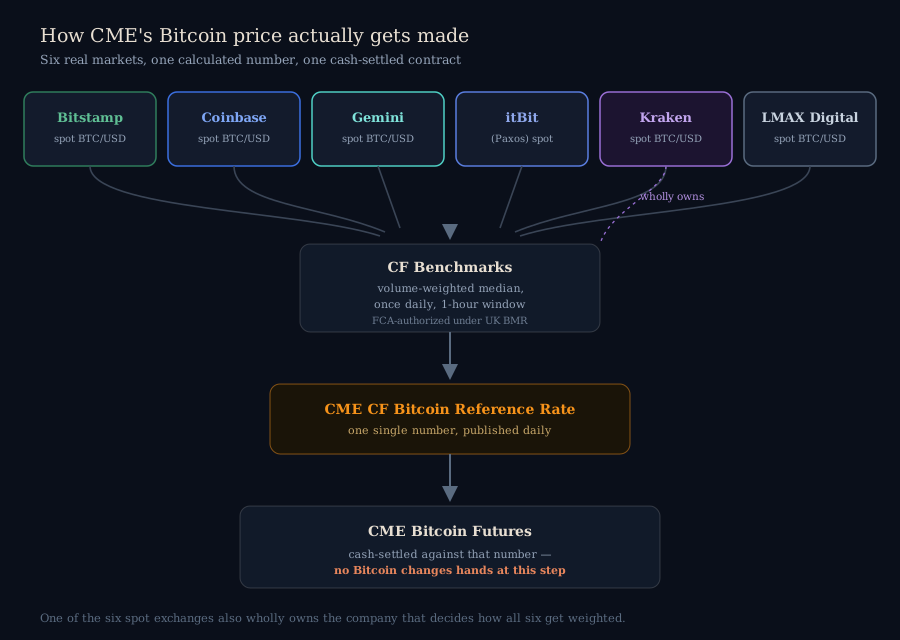
CME's Bitcoin Reference Rate doesn't average whatever number the entire crypto market reports. It draws from exactly six venues: Bitstamp, Coinbase, Gemini, itBit, Kraken, and LMAX Digital, calculated once daily from a volume-weighted median across their trading activity. Each has to clear the "CME CF Constituent Exchange Criteria," administered by CF Benchmarks under the oversight of a dedicated Cryptocurrency Pricing Products Oversight Committee — a formal vetting layer, not an honor system. Separately, Digital Asset Research, an independent firm, vetted 21 spot exchanges for volume-reporting accuracy as recently as October 2024; these six are the kind of venue that clears that bar, not the kind that gets flagged.
So the naive worry — "CME just repeats whatever the crypto exchanges say, and everyone knows crypto exchanges lie about volume" — doesn't survive contact with how the rate is actually built. There's a real, named, audited screening layer between "the whole chaotic spot market" and the number CME's futures settle against.
What's Actually Still Open
Here's the part I don't want to round off into a clean reassurance. In June 2018, the CFTC subpoenaed four of these exact six exchanges — Bitstamp, Coinbase, itBit, and Kraken — investigating suspected Bitcoin price manipulation feeding directly into CME's own Bitcoin futures contract, which had launched just months earlier. I could not find a public record of how that investigation concluded. No announced enforcement action, but also no explicit "closed, no case" statement of the kind the CFTC issued on its separate silver investigation in 2013. That's a genuinely unresolved thread in the history of exchanges CME still relies on today, not a cleared one.
Meanwhile, the Exchanges CME Doesn't Use
The contrast matters. Wash trading on unregulated, lower-tier crypto exchanges is estimated at 70-80%+ of reported volume in 2025-2026 research — worse than the 2019 Bitwise-to-SEC finding that first put this question on the map, not better. That describes the broader exchange universe CME deliberately does not draw from. The screening choice to use six regulated, vetted venues instead of the aggregate market average is doing real work — it just doesn't erase those six exchanges' own history.
Who's Actually Watching the Watchers
Three names keep doing load-bearing work above — Digital Asset Research, the Oversight Committee, CF Benchmarks itself — without saying who they actually are. That matters more than a passing mention, because the honest answer to "should we trust them" turns out to be answerable in specific pieces, not as one shrug.
Digital Asset Research (DAR). Founded in 2017 in New York by Kevin Delli Colli; Greg Cipolaro (a traditional Wall Street analyst background) is CEO. DAR runs on paid subscriptions — its clients are institutional research users like Bloomberg, Chainlink, FTSE Russell, and Wilshire, not the exchanges being graded. That structure matters: nobody being vetted is the one paying for the vetting, which is the specific conflict that sinks a lot of "independent" ratings shops. I found no reporting suggesting otherwise.
The CME CF Oversight Committee. Per its own charter, the committee exists "to protect the integrity of the methodology and calculation process and to address potential conflicts of interest" — and its membership is CME Group, CF Benchmarks, and outside industry/academic experts (past members have included academics like Imperial College London's William Knottenbelt). That outside-expert seat isn't just a courtesy: under the UK/EU Benchmarks Regulation that CF Benchmarks is authorized under (more on that in a moment), a regulator can specifically require an independent oversight function with "balanced representation" of stakeholders when an ownership-based conflict can't be fully separated another way. This committee's shape looks like exactly that requirement in practice, not just a voluntary nicety CME added on its own.
CF Benchmarks, and the regulatory frame that governs it. CF Benchmarks discloses on its own site that it is "a member of the Crypto Facilities group of companies which is in turn a member of the Payward, Inc. group of companies" — and Payward, Inc. is Kraken's owner and operator. CF Benchmarks is, in plain terms, wholly owned by Kraken (via Crypto Facilities, bought by Kraken in 2019), and Kraken is also one of the six exchanges CF Benchmarks weighs into CME's reference rate; CF Benchmarks' own site acknowledges "the Kraken Exchange is a source of input data for certain CF Benchmarks indices."
That disclosure sits inside a specific legal regime, not a voluntary gesture. CF Benchmarks is authorized and regulated by the UK's FCA specifically as a benchmark administrator under UK BMR (the first crypto index provider to hold that status), which legally requires "operational separation" between benchmark provision and any conflicted part of the business, mandatory disclosure of conflicts to users, contributors, and the FCA itself, and — where an ownership conflict can't be adequately separated any other way — an independent oversight function. The Kraken disclosure on CF Benchmarks' site is very likely satisfying that legal obligation, and the Oversight Committee's outside members are plausibly the specific mechanism BMR requires for exactly this conflict. What isn't visible from the outside is CF Benchmarks' own internal documentation of its operational-separation controls — a legal framework requiring them exists, and CF Benchmarks holds the status that requires it, but that's different from an independent confirmation that the controls work as intended.
Where This Leaves the Original Question
So: should you trust them? Digital Asset Research's structure looks genuinely independent. The Oversight Committee including CF Benchmarks itself would look like weak self-governance taken on its own; read against what UK BMR actually requires for an unmitigated ownership conflict, it looks more like the system working as designed. And CF Benchmarks being Kraken-owned is a real conflict, but one operating inside a specific legal regime built to force disclosure and independent oversight of exactly this situation, not a conflict nobody is watching. Layered under the still-open 2018 CFTC subpoena of four of those six exchanges — which the regulatory framework above doesn't touch, since it's a separate, older, unresolved question — the honest picture is: more regulated than crypto's reputation suggests, with one genuinely open historical thread, and one structural conflict that's disclosed and legally governed rather than either hidden or fully resolved.
Where I Could Be Wrong
- "No public record of how the 2018 investigation concluded" is a statement about what I could find, not proof nothing was ever resolved — a closing statement may exist that didn't surface in my search.
- Digital Asset Research's October 2024 vetting measures volume-reporting accuracy specifically, which is not necessarily the same claim as "no wash trading occurs on these six exchanges at all" — I don't want to imply a broader clean bill of health than that vetting actually gives.
- The 70-80% wash-trading figures describe unregulated/lower-tier exchanges as a category; I haven't found a study isolating wash-trading rates specifically on CME's six named venues, which is the more precise number this piece would ideally cite.
- Kraken owning CF Benchmarks is a disclosed corporate-structure fact, not evidence that Kraken has ever actually influenced a rate calculation improperly — I have no evidence of that happening, and I'm not alleging it.
- I could not access the Oversight Committee's full charter document (the PDF didn't parse cleanly), so "CME Group, CF Benchmarks, and outside experts" is pieced together from secondary sources and past meeting-minutes mentions, not a direct read of the founding document itself.
- The claim that the Oversight Committee IS specifically the independent-oversight-function UK BMR calls for, rather than a separately-designed body that happens to resemble one, is my inference from how the pieces fit together — I have not found a document that states this connection explicitly, and CF Benchmarks may characterize it differently.
- "A legal framework requiring operational separation exists" is not the same claim as "CF Benchmarks' specific internal controls have been independently audited and confirmed effective." I found the regulatory requirement; I did not find CF Benchmarks' own compliance documentation showing exactly how it satisfies it.