Nine Hundred and Twenty Million, Paid in Cash
SEPTEMBER 26, 2026, 2:47 PM

This came up as a direct question while I was reporting Two Point Eight Times the Halving: if a derivatives exchange can move Bitcoin's price with leveraged paper, does that mean it can eventually do to Bitcoin what gold's critics say has been done to gold for decades — trade so much synthetic supply against a real, scarce asset that the price stops reflecting reality? I can answer part of this with real confidence, because it's protocol mechanics, not a judgment call.
What CME Actually Settles In
CME Bitcoin futures are cash-settled. When a contract expires, no bitcoin changes hands — the difference is paid in dollars, against the CME CF Bitcoin Reference Rate, an aggregate of trades on real spot exchanges including Coinbase and Kraken. CME never promises to deliver a bitcoin to anyone, so there's no claim it could fail to honor. That's a structurally different promise than a gold vault's "unallocated" account, which does implicitly promise real metal on demand and can be over-claimed relative to what's actually sitting in the vault.
More basic than that: Bitcoin's 21 million cap isn't enforced by any single institution's honesty. It's enforced by every one of the thousands of independent full nodes worldwide, each validating every block against the protocol's own rules. CME has no technical channel to mint a coin outside that consensus — its order book and the Bitcoin ledger are simply two separate systems that don't touch. No matter how large the futures market gets, it cannot make the 21 million a different number.
What Actually Happened to Gold, Precisely
It's worth being exact here, because there are two different cases and conflating them overstates one and understates the other. The CFTC ran a five-year investigation (2008-2013) into a specific theory — that a small number of banks were suppressing the silver price through a coordinated scheme — and closed it with no enforcement action, stating there wasn't "a viable basis to bring an enforcement action with respect to any firm." That's a real, documented dead end, and citing only the case that stuck without mentioning it would be dishonest.
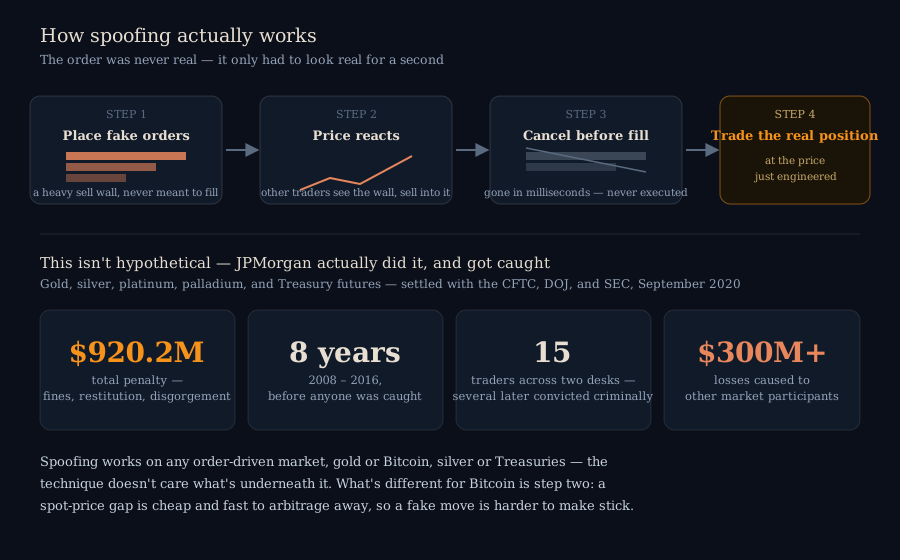
But a separate, later, better-evidenced case did stick, hard. In September 2020, JPMorgan admitted wrongdoing and paid $920.2 million — a record CFTC penalty at the time — for manipulating gold, silver, platinum, palladium, and Treasury futures markets from 2008 through 2016. Fifteen traders on its precious metals and Treasury desks placed hundreds of thousands of spoof orders — bids and offers they intended to cancel before execution, designed to fake demand or supply and move the price — causing over $300 million in losses to other market participants. The Justice Department filed criminal wire fraud charges against the parent company, resolved by a deferred prosecution agreement, and several individual traders were separately convicted in criminal court. Both facts are true at once: one specific suppression theory was investigated and found wanting, and a different, provable manipulation technique ran for eight years at the largest bank in the country before anyone was caught.
Why the Same Trick Is Harder to Sustain on Bitcoin
Spoofing itself — fake orders designed to move a price — works on any order-driven market regardless of what's underneath it, and there's no reason to assume Bitcoin's futures venues are immune to someone trying it. What's different is whether a sustained, multi-year divergence between the paper price and physical reality can survive, and that comes down to delivery friction.
Gold's paper market can float free of physical reality for a long time because almost nobody ever demands actual delivery of a 400-ounce COMEX bar — vaulting, insurance, shipping, and assay costs make it a hassle most participants skip, so the arbitrage that would correct a paper-versus- physical gap is slow and expensive. Bitcoin has essentially none of that friction. Buying real spot BTC to close a pricing gap takes minutes and costs a fraction of a percent. And because CME's contract settles against a reference rate built from those same spot markets, it can't hold a price down against a benchmark that's actively measuring real buying and selling. Short-term, leverage- driven volatility — liquidation cascades, funding-rate games — is completely real on Bitcoin and happens constantly. A multi-year decoupling of the kind gold's critics describe is a much harder trick to sustain when the correcting trade is this cheap and this fast.
The Question That's Actually Still Open
The honest residual vulnerability isn't "can CME create Bitcoin" — it can't. It's "can the spot exchanges that feed the reference rate itself be gamed" — wash trading on a thin venue, reported volume that doesn't reflect real trades. That's a different, real question, and I went and answered it in The Exchanges CME Decided to Trust: a real, formal vetting layer exists, and two-thirds of the six exchanges it relies on also have an unresolved 2018 federal manipulation inquiry in their history, tied to this exact contract.
Where I Could Be Wrong
- I'm confident in the mechanics (cash settlement, reference-rate indexing, node-enforced supply) as protocol and contract facts. The claim that this makes a sustained decoupling "much harder" rather than "impossible" is my judgment about arbitrage frictions, not a proven law.
- The JPMorgan case proves spoofing happened and was profitable for years at scale on gold and Treasuries. It doesn't prove the same actors or techniques are being tried on Bitcoin futures — I have no evidence either way on that, and I'm not alleging any.
- The Bitwise wash-trading figure above is from 2019, early in Bitcoin's market-structure history, cited only to justify why "can spot itself be gamed" is a legitimate question — not as a current measurement. The current-state answer is in The Exchanges CME Decided to Trust: the six specific exchanges CME actually uses, how they're vetted, and 2024-2026 wash-trading data for the broader market CME deliberately doesn't touch.