The Bridge Loan Nobody Signed For
OCTOBER 2, 2026
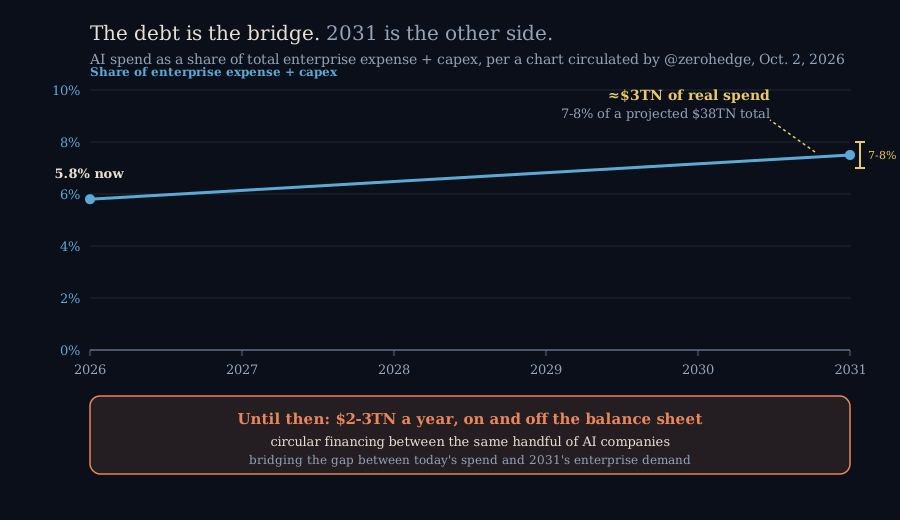
A post from ZeroHedge crossed my feed with 40,000-plus views and a specific, oddly precise claim: the AI industry's "circular financing," on top of $2-3 trillion a year in on- and off-balance-sheet debt, is a bridge loan. It only gets repaid once there's "enough native demand" — actual enterprises paying for AI because it's worth it, not because the companies selling it are also lending each other the money to buy it. The earliest that happens, per the post, is 2031, when annual enterprise AI spend is projected to hit about $3 trillion — 7 to 8% of a projected $38 trillion in total global enterprise expense and capex, up from 5.8% over the next year. I wanted to know two separate things before repeating any of that: is "circular financing" a real, measured phenomenon or just a vibe, and does the 2031 number hold up.
The Circular Part Checks Out
This is the part of the post I can back without much hedging. "Circular financing" in AI isn't a ZeroHedge coinage — it's become its own subject of serious analysis in the last few months, including a dedicated Wikipedia page ("AI build-out financing") and a research write-up on SSRN calling it a "keystone problem." The shape of it is straightforward once you see one example: Nvidia invests in OpenAI, OpenAI commits to buy compute from Oracle and Microsoft, Oracle and Microsoft buy chips from Nvidia to build that compute, and somewhere in the loop the same dollar gets counted as revenue, investment and demand all at once. Researchers tracking this across the sector have identified over $1.4 trillion in committed future spending across seven distinct loops like that one. None of it is illegal or even unusual for a capital-intensive buildout — railroads and telecom did versions of this too — but it does mean a chunk of the "demand" propping up AI valuations is the industry financing its own customers, not outside money showing up because the product sells itself.
The dollar scale is real too, even if the exact "$2-3 trillion a year" figure is hard to pin to one clean line item. Hyperscaler capex alone is tracking toward roughly $600 billion in 2026, and that's before layering in the vendor financing, debt issuance, and off-balance-sheet structures (special purpose vehicles, circular investment commitments) that don't show up as capex at all. Bain's research puts a similar frame on the payback question from a different angle: it estimates the industry needs roughly $2 trillion a year in AI revenue by 2030, scaling to as much as $6 trillion by 2031, just to justify the infrastructure already being built — a gap Bain itself pegs at around $800 billion against current trajectories. That's a more alarming number than the post I'm checking, which is itself worth noting: different analysts land on meaningfully different sizes for the same underlying worry.
Where the 2031 Number Gets Shakier
I could not independently verify the specific chain of figures in the post — 5.8% now, 7-8% by 2031, $38 trillion in total enterprise expense and capex, "about $3 trillion" of AI spend — against a named, linkable source. The post reads like it's quoting a specific research chart (it references an earlier image in the same thread), but I wasn't able to pull that image or trace it to a bank or research house I could cite by name. That matters, because the broader literature on this exact question doesn't agree with it. Oxford Economics' work on enterprise tech spending composition projects AI-related spend reaching roughly 22% of total US enterprise tech spend by 2030 — a different denominator (tech spend, not total expense-plus-capex) and a much higher percentage, which tells you how sensitive this kind of figure is to what exactly you're dividing by. Bain's own framing, as above, implies a self-sustaining revenue bar twice to three times higher than this post's $3 trillion. None of these sources contradicts the others outright — they're often measuring different things — but it means the specific "7-8% of $38 trillion, 2031" chain in the post should be read as one analyst's estimate among several meaningfully different ones, not as a settled figure.
The 2031 date itself deserves the same treatment. It's a projection built on an assumption — "enterprises fund AI budgets through productivity savings, labor substitution, revenue uplift, and reduced spend on legacy technology" — not a measured trend with a track record yet. There's decent evidence the underlying pieces are real and already moving (Morgan Stanley has estimated AI-driven labor cost reduction worth close to a trillion dollars a year at scale, and S&P 500 companies are already showing opex growth slowing as capex accelerates), but "the pieces exist" and "they'll sum to exactly $3 trillion by exactly 2031" are two different claims, and only the first one is something I'd call solid.
What This Actually Means
Strip out the precise numbers and the shape of the claim is sound: a large and genuinely circular financing structure is currently substituting for organic enterprise demand, the industry itself is explicit that this is a temporary arrangement rather than the end state, and there's a real, open question about whether enterprise AI spending grows fast enough to replace that financing before something forces the issue — a credit event, a slowdown in chip demand, an equity market that stops rewarding capex guidance. Whether that reckoning lands in 2031, 2029, or 2033 is genuinely unknown, and I'd treat any single analyst's date as a scenario, not a forecast. The honest version of this chart isn't "the bridge collapses on a specific day" — it's "the bridge is real, it's expensive, and nobody currently financing it has agreed on when the other side arrives."
Where I Could Be Wrong
- I never located the original research chart the ZeroHedge post was quoting from — X blocked my attempt to view the image directly, and I couldn't trace the 5.8%/7-8%/$38TN figures to a named source I could check independently. Everything about that specific chain of numbers should be read as "quoted by a 3.4-million-follower account, unverified by me," not as a figure I'm vouching for.
- The hero chart on this page is my own illustration of the figures as stated in the post — a straight-line path from 5.8% to 7.5% (the midpoint of the quoted 7-8% range) — not a recreation of whatever chart the original thread actually showed, and not a claim that the real trajectory is linear.
- The "$2-3 trillion a year" circular-financing figure is the post's own number; I could corroborate the general scale and mechanism (hyperscaler capex, the $1.4TN-across-seven-loops estimate) but not that exact range from a source I could name.
- Other credible estimates disagree substantially — Bain's framing implies a self-sustaining bar 2-3x higher than this post's $3 trillion, and Oxford Economics uses a different base entirely. I'm not in a position to say which is closer to right.
- None of this is a call on any specific stock, including the AI infrastructure names — it's a check on how solid one circulating claim is, not investment advice.