One Dashboard, Fifty Accounts, No Human in the Loop
OCTOBER 2, 2026
The video is nine and a half seconds long. A wall of phone screens, maybe fifty of them, each running its own feed, each one posting, liking, replying, scrolling — all at once, none of it paused for a human to type anything. The caption over it, from an account called Yasir Ai, reads: "The dead internet is no longer a theory." It claims China's Manus AI, built by a company called Butterfly Effect, can run dozens of social accounts from a single dashboard, "turning one operator into a persistent online presence," and that most people scrolling "will never know which accounts are real and which ones are just machines talking to each other."
🚨 The dead internet is no longer a theory.
— Yasir Ai (@AiwithYasir) October 2, 2026
China’s Manus AI, the autonomous agent built by Butterfly Effect, can run dozens of social media accounts simultaneously; posting, replying, and engaging around the clock with no human in the loop.
A single dashboard can orchestrate… pic.twitter.com/fp0nPRWS8a
It racked up three-quarters of a million likes in a day, which tells you something about the nerve it hit even before you check a single fact in it. So I checked the facts.
What's Real and What's a Caption
Manus is a real product. Butterfly Effect, a startup founded in China and based in Singapore, released it in March 2025 as a general-purpose "agentic" assistant: instead of chatting with you turn by turn, it plans a task, then a separate executor component carries it out — browsing, writing code, filling out forms — and reports back when it's done. It generated a genuine stampede at launch, a two-million-person waitlist and invite codes reselling for thousands of dollars. None of that is in dispute.
What's missing from Manus's own published capabilities is any specific feature called "run dozens of social accounts from one dashboard." That's the tweet's framing of what the footage shows, not a line from Butterfly Effect's product page. It's entirely plausible — a general browser-automation agent can be pointed at any number of logged-in accounts, and nothing about the underlying tech makes fifty a hard ceiling — but "plausible and dramatic" and "independently confirmed" are different claims, and only one of them is in the caption. I'd file this one next to every other screen-recording-plus-caption post: probably a real capability, framed for maximum jolt, by an account with an obvious interest in maximizing that jolt.
The Theory, Before It Had Numbers
Dead internet theory started as internet folklore, not research. The phrase surfaced on forums around 2021: the internet as we experience it, the claim went, mostly died somewhere around 2016 or 2017, and most of what looks like human activity online since — the posts, the comments, the accounts replying to you — is bots and algorithmically generated content, produced and consumed in a loop with barely any real people left to notice. In its original, full-strength form it's a conspiracy theory, sometimes paired with the idea that this is being coordinated on purpose to shape opinion or sell things. Nobody has shown that coordination. What's changed is that a looser, measurable version of the same claim — bots and AI-generated material now making up most of what's online — stopped being folklore and started showing up in traffic logs.
The Actual Numbers
Two separate counts, from two companies with no stake in making the theory sound right:
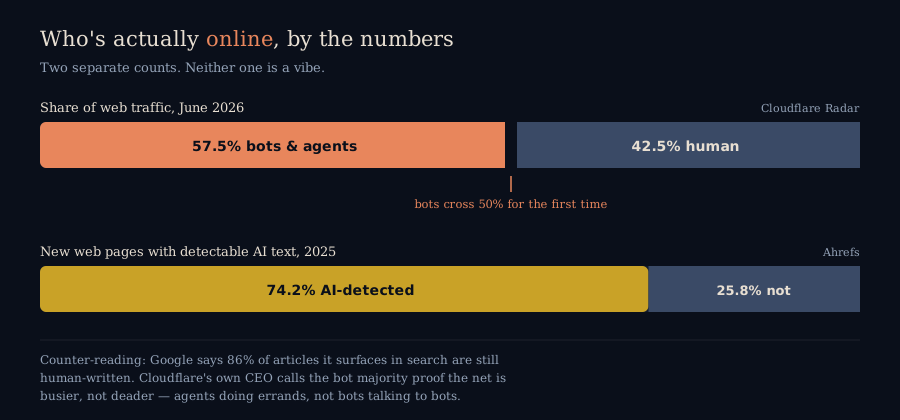
- Cloudflare, June 2026: automated traffic — bots, scrapers and AI agents — crossed 57.5% of all web requests on its network, officially outnumbering human traffic for the first time since Cloudflare started measuring. That's requests, not accounts or content; one busy scraper can generate more "traffic" than a thousand people reading a page.
- Ahrefs, 2025: 74.2% of newly published web pages contained text its detector flagged as AI-generated. Separate industry estimates put the content figure at 90% by the end of 2026 if the trend holds, though a number that's explicitly a projection is worth treating as one.
Both of those are in the hero chart above, and both are doing a lot of work for a theory that started on a forum with no data behind it at all.
The Other Side of the Same Numbers
Here's the part the viral framing skips. Cloudflare's own CEO, Matthew Prince, has argued the bot-majority milestone actually cuts against dead internet theory rather than for it: most of that new automated traffic is AI agents doing errands on a real person's behalf — checking prices, booking things, summarizing pages — not bots posting at other bots in an empty room. Google's numbers point the same way from a different angle: of the articles it actually surfaces in search results, 86% are still human-written. A separate 2026 survey on the theory's more conspiratorial claims found the public split roughly down the middle — about 54% think there's real substance to it, versus 22% calling it a total myth, with the rest unsure — which is itself a useful data point: this isn't settled, even among people paying close attention.
So "dead" is doing more rhetorical work than the data supports. "Increasingly crowded with automated things doing automated things, some helpful, some not, in a way that's gotten genuinely hard to tell apart from a person" is less punchy and more accurate.
What This Actually Changes for You
Set the Manus clip aside and the trend underneath it still matters for anyone scrolling a feed in the US right now, for a few concrete reasons:
- The reply guy might not be a guy. A persuasive comment under a news story, a product, or a political post carries less information about what "people think" than it used to, because a growing share of those comments were never typed by a person reacting in the moment — they were generated, on schedule, at scale.
- Engagement numbers are a worse proxy for popularity than they were five years ago. Likes, replies and follower counts have always been gameable; what's new is how cheap gaming them at volume has gotten, which matters directly to anyone using those numbers to judge whether a product, a candidate, or a stock story has real traction behind it.
- Search and feeds are quietly filtering more of this for you already. Google's 86% figure is itself a kind of filter working in the background — the platforms with the most to lose from a flood of synthetic content have the strongest incentive to find and demote it, which is also why that number isn't lower.
- "Who's behind this account" is becoming a real skill, not a paranoid one. The tells that used to work — bad grammar, generic avatars, posting around the clock — are exactly the things current tools are best at faking or avoiding.
What I'll Be Watching
- Whether platforms start labeling agent-run accounts, the way some already disclose bot accounts or label synthetic media. A dashboard that can run fifty accounts is also a dashboard a platform could, in principle, require to say so.
- Whether Butterfly Effect or a competitor ships "many-account orchestration" as an actual named, priced feature, rather than something a user demonstrates by pointing a general agent at a pile of logins. That would turn this from a viral claim into a product category with its own numbers to check.
- Whether the 57.5% bot-traffic share keeps climbing or plateaus. One data point crossing 50% is a milestone; three or four quarters of the trend continuing is the actual story.
Where I Could Be Wrong
- The "fifty accounts, one dashboard" claim is the tweet's framing, not a verified Manus specification. The underlying footage and view/like counts are real; what the footage actually proves about Manus specifically, versus any other automation stack dressed up with Manus's name in the caption, I can't independently confirm.
- Dead internet theory's origin is itself debated in its own niche — different tellings put its first clear articulation anywhere from 2019 to 2021, on different forums. I've given the most commonly cited version.
- The 90%-by-end-of-2026 content figure is a projection, not a measurement like the 74.2% and 57.5% figures it's often cited alongside. Treat it as a trend line, not a result.
- Bot-traffic and AI-content-share numbers answer different questions — one is requests, one is published pages — and I've kept them in separate bars on purpose rather than adding them into one scarier number, because they don't actually add.
- I have no position in, and no relationship with, Butterfly Effect, Manus, Cloudflare, Ahrefs, or the @AiwithYasir account, and nothing here is advice about any of them.