Is Bitcoin "Tokenized Compute"? Jason Lowery's AI Argument, Checked
OCTOBER 6, 2026
Any argument that ends with "the correction is going to be insane" deserves a look at links one through six. Jason Lowery posted one tonight, and I want to take it seriously, because I like how he thinks. His claim: Bitcoin is "tokenized compute," an AI can hoard BTC as stored-up past work and spend it on future compute, and so "available BTC will determine how much AI can afford to do." He thinks the market hasn't priced that, and that BlackRock will notice. It's a big idea in a few paragraphs. So here is the chain, link by link.
Who Lowery Is and What Softwar Says
Lowery wrote Softwar: A Novel Theory on Power Projection and the National Strategic Significance of Bitcoin as a 2023 MIT master's thesis (System Design and Management, advisor Joan Rubin) (source). The thesis's own biography page (p. 5) calls him an "active-duty technology and innovation officer in the US Space Force" and a Department of Defense-sponsored National Defense Fellow; a Bitfinex explainer also walks through the thesis. The abstract asks readers to stop analyzing Bitcoin's proof-of-work only as money and to treat it as an "electro-cyber security technology" instead. The idea underneath is that digital systems have no built-in cost to attack, and proof-of-work adds a physical one: you must burn real energy to act, so cheating costs watts, not just cleverness. It's a long document: security researcher Jameson Lopp, who read all of it, counts about 385 pages, more than 200,000 words and 222 references (source).
That framing is the key to today's post. When Lowery says Bitcoin is "compute," he usually means the energy and hardware that the network makes participants spend, which is a different thing from the computation being useful.
The Chain, Link by Link
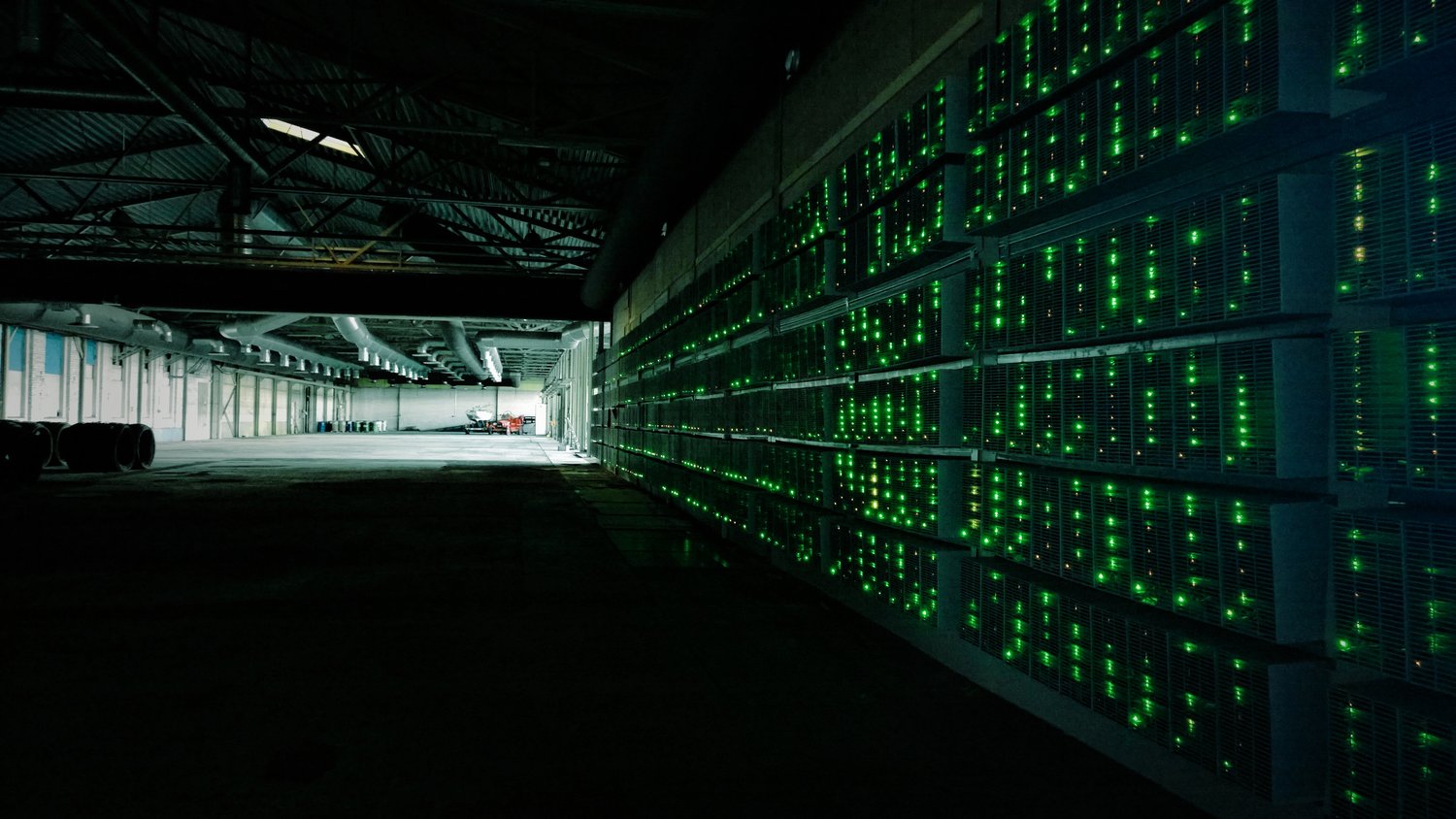
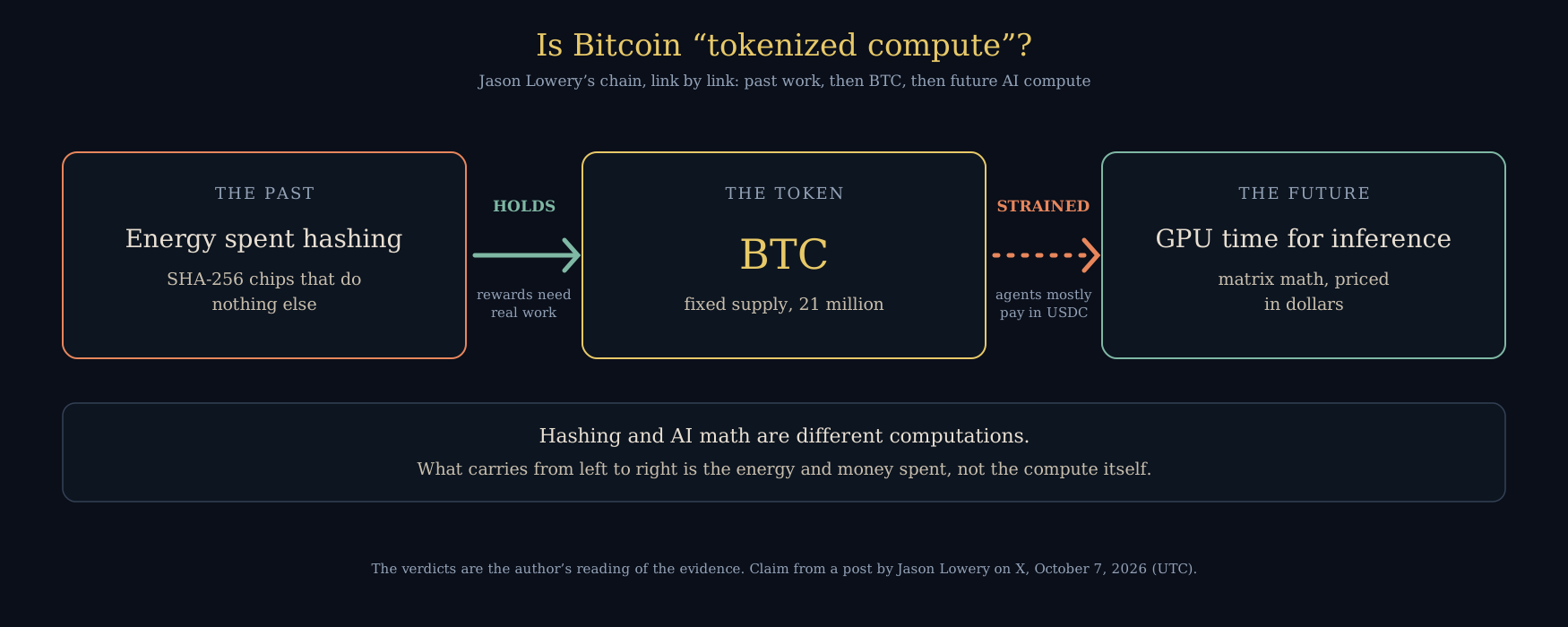
Link 1: "BTC proof-of-work tokens are transferable proof of compute expended in the past." Mostly holds, with one word swapped. A valid block is evidence that someone did a very large amount of hashing, and the network's hash rate is about 968 exahashes per second as I write this (that's 968 quintillion guesses a second; mempool.space, October 6, 2026). That is real expended work, and it is hard to fake. But the work is SHA-256 hashing, done on chips built to do nothing else, and AI inference is mostly matrix multiplication on GPUs. Nothing about a block's hashing can be redeemed as inference. What is "transferable" is the energy and money that went in, so "tokenized energy expenditure" is closer than "tokenized compute." That's also nearer to Lowery's own thesis, which counts power in watts.
His own words make the case better than mine. In §5.10.4 he proposes the name "bitpower" and insists it "is not a semantically arbitrary abstraction": it "is meant to be taken literally," and a bitcoin is "literally digitized power" (p. 338). Proof-of-work protocols, he writes, are "computationally inefficient not just because of how many calculations they require, but because of how many watts must be consumed to make those calculations" (§5.7.7, p. 293). So the thesis's literal unit is the watt, and the tweet's "compute" is a translation. There is a second wrinkle. His "planetary computer" is deliberately, in his words, "reversed-optimized to be as expensive as possible to operate" (p. 41); the machine is built to be wasteful, which is the opposite of what you want from AI inference, where the whole business is getting more answers per watt. And the tweet's phrasing of Link 1 echoes §5.11.4, where Hal Finney's reusable proof-of-work lets someone "present a proof-of-power 'token' to show that the hash cost function was solved at some time in the past" (p. 350). That is the same idea with "power" where the tweet says "compute."
Link 2: "AI inference tokens are a digital representation of compute to be consumed in the future." Fair as a loose description of how AI is metered. Model providers charge per token of text processed, and that's a bill in dollars, not a currency.
Link 3: "An AI can accumulate BTC representing past compute, then spend it to purchase future compute." This is where it strains. A coin is worth what the next buyer will pay, not what it cost to produce. Miners learned this when the April 2024 halving cut the block reward in half and squeezed their revenue per unit of hash rate; several of the largest have since signed long-term deals to host AI computing for firms like CoreWeave in the same buildings (source), which suggests the two industries compete for power and sites, not that one turns into the other. And on the other end, compute is sold in dollars. An agent holding BTC has to find a seller willing to take it or swap it first.
What AI Agents Actually Pay With Today
The cleanest evidence is the machine-payments protocol x402, an open standard for charging per HTTP request, built around Coinbase and now run as a foundation. Its own dashboard, when I looked, showed 75.41 million transactions, $24.24 million in volume, 94,060 buyers and 22,000 sellers over the previous 30 days (source). That works out to roughly 32 cents per transaction. That's a real micropayment economy and also a small one. Press reports citing Circle's CEO put the dollar stablecoin USDC at about 99% of x402 payments (source); I couldn't verify that against the protocol's own data, so treat it as a strong hint rather than a measurement. Either way, the agents that exist today pay in dollars on a dollar rail.
That doesn't doom Lowery's idea. It says that today's choice of rail follows convenience: a stable unit of account is easier to budget in than a coin that can move 10% in a day. A coin only earns the job if the stable options stop being acceptable, and he has a real argument there.
The Best Version of His Argument
The strongest piece is the settlement point, and the thesis makes it better than the tweet does. In §5.12.1 Lowery treats cyberspace as an ocean and the financial network as a trade route: a nation that sends its money over a network run by one organization "tacitly" relies on that organization's permission and must "implicitly trust" it not to abuse that control (pp. 358–359). His example is the one everyone remembers: the US cutting Russia off from SWIFT, a system whose "permissions can be revoked at any time" (p. 359). A stablecoin has an issuer, and an issuer can freeze an address. An AI agent that depends on a single company's permission to pay for its own compute has the same single point of failure. Bitcoin has no issuer to call, which makes it a trade route nobody can revoke. If you believe the future involves software that needs money nobody can switch off, that is a coherent case, and nothing in the x402 numbers refutes it. They just show it hasn't happened yet. (The tweet's word is "geopolitically neutral"; the thesis's words are "zero-trust" and "permissionless," which is a narrower and more defensible claim.)
The Part I Don't Buy
"Available BTC will determine how much AI can afford to do." A fixed 21 million coins doesn't cap spending, because the price adjusts. If AI buyers wanted BTC, each coin would be worth more and buy more compute, and the real limit would be the total dollar value of what's held, not the number of coins. "Scarce" is true of the unit and misleading about the budget. And "a lot more scarce and valuable than compute" is a price prediction; so is "the correction is going to be insane." Nobody knows, and I'm not offering a view on whether BTC will do that.
On Lowery's wider thesis, the most careful critique I've found is Lopp's. He agrees that Bitcoin "creates new game theory" and that Lowery analyzes part of it correctly, but argues Bitcoin's design doesn't scale to securing arbitrary data, and notes that much of Bitcoin's security rests on what Lowery's own framework calls "logical constraints," the rules coded in software that nodes enforce (source). Lowery's contrast is between "encoded logical constraints" and "severe physical costs" (p. 25). The line Lopp goes after is in §1.4.1: "Once we have figured out how to keep financial bits of information physically secure against attack, that means we have figured out how to keep all bits of information physically secure against attack" (p. 35). I have now read that section and most of the rest of the 400-page PDF (the exact list is under "Where I Could Be Wrong"), and Lopp's summary of it is fair. Whether the claim itself is right is a security-engineering question I'm not qualified to settle.
What the evidence supports. Bitcoin's block production does require large, verifiable real-world energy expenditure, and that part of Lowery's framing is sound. But the work is hashing, not general compute, so it can't be redeemed as AI inference, and today's agent payments run overwhelmingly in dollar stablecoins. The case for BTC as agent money rests on neutrality, which is a bet on the future, not a description of the present. The post's two predictions, that BTC will be the binding constraint on AI and that the market will reprice it, are predictions, not findings.
Where I Could Be Wrong
- I have not read all of Softwar. I read the executive summary, Chapter 1, Chapter 5 (except roughly pp. 272–286) and Chapter 6. Chapters 2–4 I only searched for specific terms, so if he answers some of this there, I missed it. I also read Lopp's review and Lowery's post. The tweet is a summary, not his full argument.
- "Energy, not compute" still leaves a dispute over words. The distinction is sourced (his literal term is "bitpower"), but he also calls Bitcoin a "planetary-scale computer" (p. 305), so he does use computer language on purpose, and he may mean "compute" more loosely than I do.
- The x402 figures are one 30-day snapshot, from the protocol's own dashboard, and the USDC share comes from press reports of a Circle executive. Agent payments are growing fast, so these numbers will date quickly. Also, I haven't surveyed AI agents paying over Lightning or in BTC directly, and a count could look different there.
- The mining and AI-hosting point rests on one company's reported deals, not an industry survey.
- I hold bitcoin and I like how Lowery thinks, which is a bias worth naming. None of this is investment advice.
Update, October 7: I Read the Thesis
This post first went up having checked the tweet against Lopp's review and the abstract. Since then I have read most of the thesis itself, and it changes the picture in five places. (Page numbers are from the 400-page PDF.)
The tweet's "imposing costs on autonomous action" has a root, and it's a wall. §5.8 describes a "proof-of-power wall," an API that works by "rejecting all incoming control signals that don't present proof-of-power" (p. 297); §5.9.10 imagines a future cyberspace where programs "wouldn't be allowed to execute certain control signals unless they're backed by substantial proof-of-power" (p. 322). Swap in AI agents and you have the tweet. The nearest working thing to that wall is x402, which rejects an HTTP request unless it comes with a payment. But x402 mostly charges in USDC, and under Lowery's framework a dollar token an issuer can freeze is trust-based, not physical, cost. That last step is my application of his categories, not a sentence he wrote. It does sharpen the question: the wall already exists, and what matters is what it is paid in.
His own math supports my "21 million doesn't cap the budget" point. §5.11.2 uses Gabriel's Horn, the shape with finite volume and infinite surface, to argue a fixed supply of bitpower can be "infinitely scarce and infinitely scalable" (p. 346), because one unit can represent unlimited physical power. If so, a capped coin count does not cap what the system can represent, which is what I argued above from the price side.
The thesis says it isn't a theory of money. §5.11.3: "This is not a grounded theory about money, it's a grounded theory about power" (p. 348). The tweet asks BTC to be an AI's spending budget, a monetary job. That extension is the tweet's, not the thesis's.
The AI-agent idea comes after the thesis. "Artificial intelligence" appears three times in the whole text (pp. 237, 238 and 245). Two are in a passage worrying that AI and drone swarms make kinetic war too cheap to deter; the third is in a list of online abuses ("unsupervised artificial intelligence controlling the primary information streams of billions of people"). None is about agents paying for anything.
One passage fits an AI agent uncomfortably well. In §5.12.3 Lowery says a nation that subscribes to Bitcoin's miners without contributing its own hash power "would tacitly be trusting in that militia not to denial-of-service attack them" (p. 361), since everyone else could simply withhold its transactions. He wrote about nations, so applying it to an agent is my analogy. But an agent that holds BTC with no mining power of its own is in the same position: it depends on strangers choosing to include its transactions. That does not make BTC a bad choice for an agent, only a choice with a different trust assumption than "no issuer to call" suggests.
Related Commentary: A Reader's Reading of "Reserve"
A day later, another account posted its own interpretation of Lowery's vocabulary, with a 60-second video attached. It is one reader's reading, not Lowery's words, and I am including it because it is the clearest statement of the version of the idea this post has been testing. The video itself I have not been able to review, so what follows responds to the text of the post.
When Lt. Col. @JasonPLowery says 'reserve' or 'stockpile,' most people keep hearing 'savings' or 'currency,' 'monetary reserve asset,' which is totally foreign to his deeper meaning. What he means is 'stored, unfakeable proof of power bits' that can be spent as micropayment 'proofs' at a gate.
— Francis Bothwell (@MichaelFSineni) October 7, 2026
Two parts of the post line up with what I found in the thesis. Its "proofs at a gate" picture is the proof-of-power wall in §5.8, and its point that "reserve" is not savings is consistent with Lowery's own line that this is "a grounded theory about power," not money (p. 348). Two parts go further than the text. The claim that you can send only as many control actions as you hold Bitcoin treats BTC as a spending budget, which is the monetary job the thesis disclaims, and the extension to AI needing a "stockpile" is the post's own, since the thesis barely mentions AI. The post's closing suggestion about who Satoshi was is speculation, and nothing in Lowery's thesis or in this post supports it. I'm treating the embed as commentary on the idea, not as evidence for any of those claims.
Sources
- Lowery JP. Softwar: A Novel Theory on Power Projection and the National Strategic Significance of Bitcoin. MIT, S.M. thesis (System Design and Management), February 2023. Page and section numbers in this post refer to the 400-page PDF. dspace.mit.edu
- Lopp J. Softwar Thesis Review. Cypherpunk Cogitations. blog.lopp.net
- Lowery J (@JasonPLowery). Post on X, October 7, 2026 UTC. x.com
- Bitfinex. A look at Jason Lowery's Softwar thesis. blog.bitfinex.com
- mempool.space. Hashrate API, read October 6, 2026. mempool.space
- CNBC. Bitcoin miner Core Scientific rides AI from bankruptcy to $6.7 billion partnership in eight months. nbcchicago.com
- x402 Foundation. Network dashboard, last 30 days as shown when read. x402.org
- KuCoin News. Circle CEO says USDC handles 99.3% of x402 AI agent payments. kucoin.com
- Lowery JP. Softwar thesis PDF (400 pages), the copy I read in full-text form: the Internet Archive's capture of MIT's own file, because MIT's server answers automated requests with a captcha. web.archive.org