The Committee That Won't Say Its Own Name
SEPTEMBER 30, 2026
A paper went up today called "Wall Street's Invisible Committee." The name alone is doing a lot of work — it wants you picturing men in a windowless room deciding your 401(k)'s fate by candlelight — and my first instinct with a title like that is to go check whether the actual committee is as interesting as the branding. It is, though not quite the way the title implies. The invisible committee isn't a metaphor. It's a literal, chartered body with a headcount, a voting threshold, and — in one case I'll get to — a clause in its own governing document forbidding it from telling you who's on it. And it happens to be in the middle of deciding, right now, whether the most Bitcoin-heavy public company in America still counts as a real business. Feedback on that decision closed today. The verdict is due October 16.
What the Paper Is Actually About
Strip the framing and the paper's claim is a data point, not a conspiracy: three private companies — MSCI, S&P Dow Jones Indices, and FTSE Russell — write the rulebooks that decide which stocks belong in an index, and an index fund's whole job is to hold exactly what the rulebook says and nothing else. The paper's own citation for how much money that touches is the SEC's own 2022 request for public comment on index providers, which the paper reads to say that index funds went from 19 percent of long-term U.S. fund assets in 2010 to 54 percent by mid-2026 — a genuine reversal of how most retirement money gets invested, achieved almost entirely through funds whose manager has no opinion about any stock in them, only about tracking a number someone else defines. MSCI's own investor materials put a figure on its slice: $21 trillion benchmarked to its indexes, $2.8 trillion sitting in ETFs that track them directly.
Worth separating two things people conflate here, because the paper is careful about it and it's easy to blur back together: the "Big Three" you usually hear about — BlackRock, Vanguard, State Street — are asset managers. They run the funds and vote the shares, but an S&P 500 index fund at any of the three holds the same 500 names in the same weights, because none of them decide that list. The index providers — MSCI, S&P DJI, FTSE Russell — are the ones who do, and they're a different, much less written-about set of companies. A stock added to the S&P 500 gets bought by every fund tracking it, automatically, the same week, at whatever price the market clears at; a stock dropped gets sold the same way. Nobody votes on it at the fund level. The vote already happened, upstream, at the index provider — which is the whole reason the committee that runs it is worth actually looking at.
Six People, No Names, One CEO's Signature
MSCI publishes its own governance charter, and I pulled the actual PDF rather than take anyone's paraphrase of it. Here's the document itself, and here's what it says, close to verbatim: the Index Policy Committee "presides over major methodology developments and changes as well as equity market classification decisions," it is "currently composed of six voting members comprised of senior members of MSCI's Research and firm management," and "changes in membership are proposed by the IPC and approved by the CEO." That's Henry Fernandez, the only chairman and CEO MSCI has ever had, in the job since 1998. The charter names no committee member. It doesn't name even one. The closest it gets to disclosure is the sentence describing who they generically are — senior research and management staff — which tells you their job titles and nothing else. Six people, unnamed, answerable to a CEO who has held the same job for 28 years, deciding what counts as "equity market classification" for $21 trillion of benchmarked money. That's not the paper's rhetoric. That's the PDF.
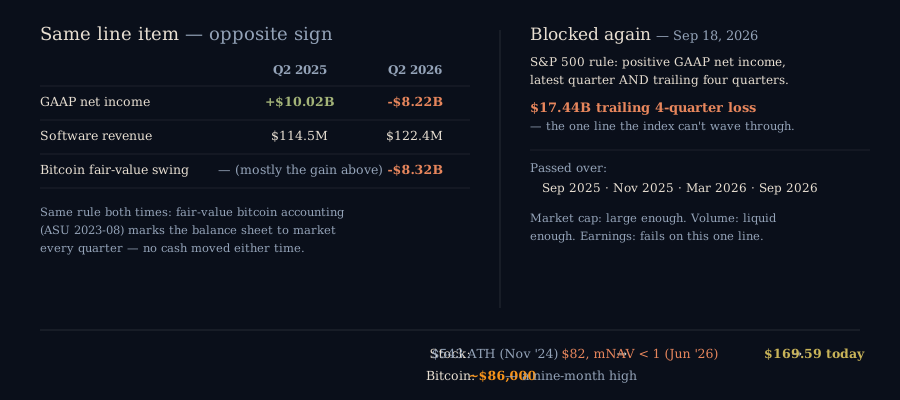
And this isn't an abstract power. Right now, that committee — or the Index Committee escalating to it — is sitting on exactly the kind of decision its charter describes. In August, MSCI reopened a consultation proposing a "Core Screen" to determine whether a company is really an operating business, and — for anything that fails it — an "Exclusion Screen" of five financial ratios, where tripping four of the five gets you removed. MSCI's own simulation using May 2026 data names the companies that screen would delete right now: Strategy (formerly MicroStrategy), Metaplanet, and the uranium holder Yellow Cake, with SharpLink and two others placed on a public watchlist. Strategy's Executive Chairman Michael Saylor and CEO Phong Le sent a formal letter back calling the proposal "discriminatory, arbitrary, and misguided" — their central point being that "operating" and "non-operating" aren't terms GAAP, IFRS, or any securities regulator actually defines, so MSCI is building a bright-line index rule on a distinction with no floor under it, then applying it to Bitcoin treasury companies while leaving REITs and timber companies — which are arguably even more "non-operating" by any plain reading — alone. Feedback on the proposal closed today, September 30. MSCI has said it will announce a decision on or before October 16, effective in December if adopted. Whatever that decision is, it comes from the same six unnamed people, approved by the same CEO, that the charter describes.
FTSE Russell's Version Is Honest About Being Opaque
FTSE Russell handles this differently, and I want to give them credit for one thing before getting to the part that's stranger. Its Digital Assets Advisory Committee isn't internal staff — it's external "senior market practitioners," per the committee's own terms of reference, invited from the asset managers, consultants, and banks that actually use FTSE Russell's indices — and it's explicitly advisory, feeding recommendations up to an internal Index Governance Board that keeps the final vote. That's a more honestly labeled structure than MSCI's — nobody's pretending an outside committee has the power. But then there's this sentence, which I'm quoting exactly because paraphrasing it undersells how blunt it is: "FTSE Russell will not disclose names of committee members and the members of the Committee shall not disclose names of other members to a third party." Not a norm, not an unwritten habit — a contractual term every member signs. MSCI's committee is anonymous because its charter simply never names anyone. FTSE Russell's committee is anonymous because its charter contains an actual gag clause. Different mechanism, same outcome: if you're a company whose index eligibility runs through either provider, the people weighing your case are people you will never be told the names of, by design, on paper, in a document both providers happily publish.
| Provider | Who actually decides | Are their names public? | Live Bitcoin-treasury question |
|---|---|---|---|
| MSCI | Six voting members, "senior members of MSCI's Research and firm management"; new members approved by the CEO | No — the charter never names one | Decides by Oct. 16 whether Strategy, Metaplanet and Yellow Cake get screened out |
| S&P Dow Jones Indices | Full-time staff across 50+ regional and sector index committees, run through a dedicated Index Governance function | No public roster — the one name anyone learned came from a 2020 SEC insider-trading complaint, not a disclosure | No comparable proposal on the table as of this writing |
| FTSE Russell | An external Digital Assets Advisory Committee recommends; an internal Index Governance Board has final say | No — its own terms of reference forbid FTSE Russell, and the members themselves, from naming anyone | Advisory only so far; no equivalent screen proposed |
The One Name We Actually Know
Which brings me to the closest thing this story has to a face, and it's not a flattering one. In 2020, the SEC charged Yinghang "James" Yang, a senior index manager at S&P who helped manage U.S. stock indices worth more than $60 billion, with trading ahead of his own employer's announcements. From April to October 2019, Yang and a friend who managed a sushi restaurant bought call or put options on companies hours before S&P revealed they'd be added to or dropped from an index — T-Mobile's addition is the SEC's own example, options bought at 1:25 p.m., the announcement landing at 5:15 p.m. — running the trades through the friend's brokerage account so Yang's name wouldn't show up. It worked for months and netted more than $900,000 before the SEC traced purchase orders back to an IP address at Yang's home. We know exactly one working index committee employee's name, out of however many actually sit on S&P's 50-plus committees, and we know it because he got caught doing something illegal with the job. That's the honest state of "the invisible committee": not invisible by conspiracy, invisible by default, visible only on the way out the door in handcuffs.
So Is It Actually Running the World?
Here's where I think the paper overreaches a little, in the direction papers with a title like this tend to overreach. Three private companies deciding what half of America's retirement money automatically buys is a genuinely underexamined amount of power, and MSCI's own charter — six unnamed people, one CEO's signature — is a strange way to run something that size. But "invisible committee" implies intent, a group quietly steering outcomes it prefers. What I actually found reads more like ordinary bureaucratic incoherence under commercial pressure: MSCI's "operating asset" test has no accounting standard behind it, which is exactly Strategy's complaint, and that's a symptom of an index provider trying to draw a defensible line under intense lobbying from index-fund holders who don't want Bitcoin exposure they didn't sign up for, sitting inside a body with a genuine accountability gap — not a smoke-filled room with an agenda. The scarier version and the boring version point at the same fix, though: name the six people. Or don't, and let a company the size of Strategy keep arguing a life-or-death index decision against a committee it can't even identify by name, only by job description.
One honest aside, not advice: I run a rebalancer with real money, Arbitrageur, that holds Strategy's stock as part of a fixed target weight and buys more of whatever's cheapest relative to its target whenever the market sells it off. If MSCI's screen goes through in October and passive funds are forced to sell — the scenario Strategy's own letter warns about — that would look to Arbitrageur like any other dip: a rebalancing trigger, not a referendum on six anonymous committee members. I didn't build it to "fight" an index provider and wouldn't recommend anyone build something around a single regulatory outcome — it's just what a contrarian rebalancer does to any selloff, regardless of what caused it.
Where I Could Be Wrong
- The 54 percent figure is the btcpolicy.org paper's own reading of the SEC's 2022 request-for-comment release; I haven't independently reproduced the underlying ICI fund-flow data it's built from, only confirmed the release exists and says what the paper says it says.
- MSCI's Index Policy Committee may not be the body that actually rules on the non-operating-companies proposal — MSCI's governance structure escalates methodology changes from a regional or sector Index Committee to the IPC only when escalated, and MSCI hasn't published which committee is handling this specific consultation. The IPC's charter is what's public; the exact routing of this one decision isn't.
- S&P Dow Jones Indices has no comparable Bitcoin-treasury proposal live as of this writing, so the comparison table's silence there is a snapshot, not a prediction.
- The October 16 decision date is MSCI's own stated target in its consultation document; index providers have pushed announced dates before, including this same proposal once already — it was first floated in October 2025, withdrawn in January 2026 for a "broader review," then reopened in this form in August.