The Great Power That Can't Use SWIFT
SEPTEMBER 30, 2026
I went down this road because of a question, not a headline. Someone asked me why Medvedev keeps explaining why Putin fights — why a former president who spends most of his public life threatening NATO with nuclear weapons also spends part of it doing something closer to philosophy. The short version I gave was: the Kremlin's own framing is that this isn't a war of choice, it's existential — Russia either stays a great power or it stops being a coherent country at all, and everything else follows from that. I believed my own summary. Then I went and checked what it was resting on, and the rhetoric turned out to have a very literal, very well-documented floor under it.
What Medvedev Actually Said, and When
The line is real and it's recent. Addressing regional secretaries of the ruling United Russia party on September 16, 2026, Dmitry Medvedev — deputy chairman of Russia's Security Council — said: "Our country can either be a great power, or it will not exist at all. Such are the laws of history." It's not a new theme for him; he's leaned on versions of it since at least 2022. What it does, stated that plainly, is collapse the distinction between "losing territory" and "ceasing to exist." In that framing there's no such thing as a limited, contained defeat — any real retreat reads as the first domino, the way 1917 and 1991 read in hindsight. That's the case for why the war doesn't stop. It's also, not coincidentally, the case for why nuclear rhetoric keeps resurfacing every time the conventional picture looks bad for Moscow: if losing is existential, almost anything short of losing gets rationalized as proportionate.
I'm reporting that as the Kremlin's own argument, not as an assessment of whether it's true. It's also worth saying plainly what it is for: it's addressed to a domestic audience whose support the war still needs, from an official whose own political relevance depends on the war not being treated as a mistake. Believing the framing and finding it internally coherent are different things.
The Door That Closed in February 2022
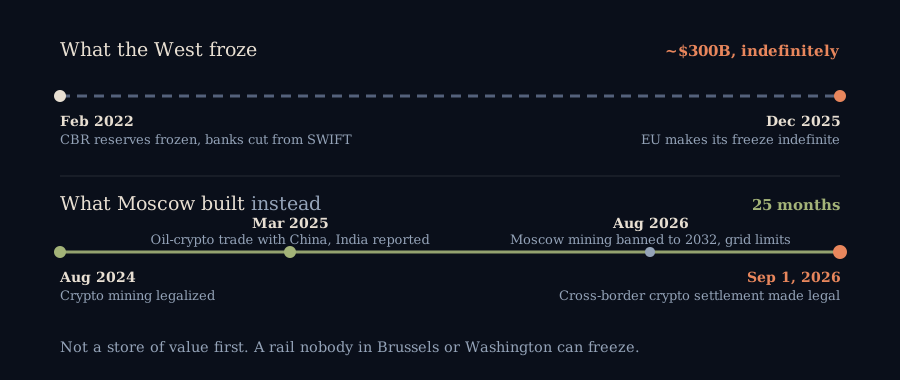
Here's the part that isn't rhetoric. When the EU, US, Japan and Canada froze roughly $300 billion of Russian central bank reserves in late February 2022 and cut a set of Russian banks off SWIFT, they weren't sanctioning a company or a person. They froze a sovereign state's own savings — about $200 billion of it sitting in Europe, mostly at the Belgian clearing house Euroclear — and made it impossible for Russia's central bank to use its own money to defend the ruble or settle trade the normal way. That freeze wasn't temporary housekeeping, either. On December 12, 2025, EU governments agreed to make their share of it indefinite — removing the six-month renewal vote that Hungary or Slovakia could have blocked — specifically to back a €165 billion loan to Ukraine that gets repaid only out of a future Russian reparations payment. Read that plainly: the interest on Russia's own frozen money is now funding the war against it, by design, for as long as it takes. If you were looking for the single most concrete instance of "the West is trying to destroy Russia" that a Kremlin official could point to without saying anything false, this is it. You don't need Medvedev's civilizational framing to find this menacing from Moscow's chair — you just need a bank statement.
The Rail Russia Built Instead
A state that's been cut out of the dollar-clearing system and had its own reserves seized has exactly one urgent problem: how does it get paid for anything. The answer Russia has been building, in public, on a timeline that predates every headline this week, is crypto — not as an investment thesis, as plumbing.
Russia legalized crypto mining in August 2024, ending years of regulatory limbo. By March 2025, Reuters was reporting — four sources with direct knowledge, via The Moscow Times' coverage of that reporting — that Russian oil firms were already settling trade with China and India in bitcoin, ether and Tether: a Chinese buyer pays a middleman in yuan, the middleman converts to crypto, the crypto moves to an account in Russia and comes out in rubles. One trader's volume alone was running "tens of millions of dollars a month." None of that needed a new law to happen — it happened in the gap where no law existed yet. The law caught up on September 1, 2026, when Russia's "On Digital Currencies and Digital Rights" statute took effect: licensed intermediaries, a retail cap around $3,800 a year, domestic crypto payments still banned — but cross-border trade settlement in crypto made fully, explicitly legal. That's the specific slice of the law Moscow actually needed. It has almost nothing to do with ordinary Russians buying bitcoin and everything to do with a state that lost access to the normal wire needing a different one.
The mining side of the story is the same shape, with a domestic complication worth stating honestly. Russia has become the world's second-largest bitcoin mining country, at roughly 16.4% of global hashrate as of Hashrate Index's Q1 2026 report — behind only the United States — built on cheap Siberian gas and hydro. But Moscow itself isn't cheering this on unconditionally: in August 2026 the government extended its mining ban to Moscow and the Moscow region through 2032, citing grid capacity, on top of bans already running in the North Caucasus and several other regions since 2025. Russia wants the sanctions-proof settlement rail. It does not, at the same time, want energy-hungry mining rigs competing with its own cities for power in winter. Both things are true and they pull in opposite directions inside the same government.
A Note on Gold, Which Doesn't Fit This Story As Cleanly
If the thesis were simply "sanctioned states flee to hard assets," gold should tell the same story crypto does. It doesn't, and I'd rather flag that than smooth it over. In the same Q1 2026 window where central banks overall kept buying gold, Russia was one of three countries — alongside Turkey and Azerbaijan — that turned net seller. That complicates a tidy "Russia is de-dollarizing into hard assets across the board" narrative. What it doesn't complicate is the narrower claim this piece is actually making: Russia's crypto pivot isn't about wanting a store of value nobody else controls — gold has always offered that, and Russia sat on its gold stockpile for years before this year's wobble. It's about wanting a settlement rail nobody else can freeze mid-transaction, which is a problem gold was never good at solving for cross-border trade at speed. Bullion still has to physically move or sit in a vault someone else could sanction. A blockchain settles in minutes and answers to no custodian. That's a different problem than "what do I hold," and it's the one Russia's actual 2024–2026 policy record has been solving for.
What I'll Be Watching
- Whether the $3,800 retail cap moves. If Moscow starts loosening the domestic side of the law, that's a state getting more comfortable with crypto as policy rather than as an emergency valve.
- The digital ruble. A state-run alternative to open crypto rails would tell you Russia wants the sanctions-resistance without the parts of crypto it can't control — worth its own entry once the rollout has real numbers.
- Hashrate under the Moscow ban. Whether Russia's 16.4% share holds, grows in regions the ban doesn't reach, or actually contracts once 2032's grid-relief argument gets tested sooner by an unusually cold winter.
- Any official number on crypto-settled trade volume. Everything cited above is investigative reporting and one law's text — Russia itself has never published a figure for how much of its trade now clears this way.
Where I Could Be Wrong
- Medvedev's September 16 remarks are cited from a single secondary report (UNN, an Ukrainian outlet) of a domestic Russian speech; I have not located an English transcript from a Russian state source, and translation nuance in a "laws of history" line matters.
- "$300 billion frozen" is the commonly cited 2022 figure; estimates in later reporting range from $280 billion to $330 billion depending on what's counted and at what exchange rate, and the total has moved since as maturing bonds were drawn down for the Ukraine loan.
- The March 2025 Reuters oil-crypto reporting rests on four anonymous sources Reuters didn't name, which is standard for sanctions-evasion reporting but means I can't independently verify the "tens of millions a month" figure.
- Russia's gold net-selling in Q1 2026 could reflect near-term liquidity needs rather than a strategic decision to prefer crypto over bullion going forward — one quarter, three countries, is a thin base for either reading.
- I'm not assessing whether the war is justified, and nothing here should be read as endorsing the Kremlin's "existential" framing as fact rather than as its own stated case. I'm reporting what officials said and what the sanctions and legal record actually show.
- I hold Bitcoin (through an ETF) and Strategy Inc. I have no exposure to any Russian entity, ruble-denominated asset, or sanctioned counterparty, and none of this is investment advice.