The Coins Exchanges Won't Let Back In
SEPTEMBER 29, 2026
A question came in about a mechanism I hadn't seen anyone actually size: if exchanges are getting pickier about accepting Bitcoin that's passed through a CoinJoin mix, doesn't that shrink the pool of coin available to buy, on top of everything else already squeezing the float? It's a good question, and the honest answer took some digging — because the pieces of it are well documented individually, and nobody seems to have put them next to each other.
What CoinJoin Actually Is
CoinJoin is a real, working privacy technique, not a hypothetical. Several people who want to break the link between their old coins and their new ones combine their transactions into one big joint transaction with many equal-sized outputs, so an outside observer watching the chain can no longer tell which input paid which output. Nobody's coins are pooled or held by a third party — it's one atomic transaction, cryptographically enforced, that a participant's wallet builds and signs itself. A peer-reviewed measurement study presented at the 2026 Privacy Enhancing Technologies Symposium put a number on how much of this has actually happened: coordinator-based CoinJoin implementations have mixed more than 391,000 bitcoin since 2018 (Svenda, Gavenda, Mavroudis and Hicks, PoPETS 2026). That's not a fringe number attached to a fringe practice.
It's also not what it was two years ago. In April 2024, U.S. federal prosecutors arrested Samourai Wallet's founders and charged them with money laundering; its Whirlpool CoinJoin service went dark that same day. Six weeks later, zkSNACKs — the company that ran Wasabi Wallet's coordinator — voluntarily shut its own service down, citing the same regulatory pressure. For a moment, CoinJoin looked like it might be over. It wasn't: an independent, community-run coordinator called kruw.io picked up Wasabi's protocol and now handles essentially all of it — 99% of mixed inputs, per the same study — and has mixed over 46,000 BTC in the eighteen months since, more than the old coordinator was doing before it shut down. Arresting the operators didn't stop the practice; it just moved who runs the coordinator.
What Exchanges Do With a Mixed Coin
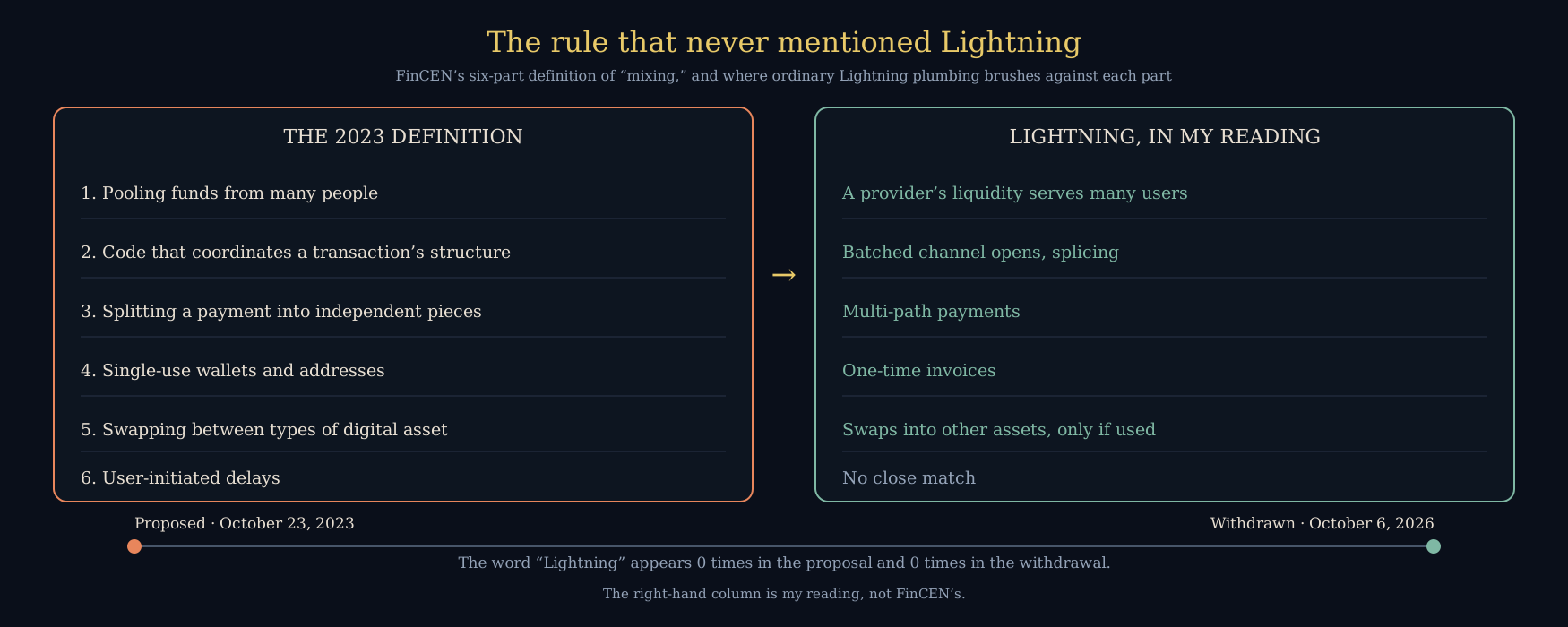
Here's the part that actually connects to Michael's question. Since 2019, FinCEN guidance has treated mixing services as money transmitters, and every major regulated exchange subscribes to a blockchain-analytics vendor — Chainalysis, Elliptic, and others — that scores every incoming deposit against a database of known addresses and behaviors. CoinJoin output is one of the categories that database flags, and it's flagged specifically because a CoinJoin's whole purpose is to make the "where did this coin actually come from" question unanswerable — which is precisely what an anti-money-laundering system is built to answer. Exchange users have repeatedly and publicly reported deposits frozen or accounts sent to manual review after sending post-mix coins to Coinbase, Binance and OKX. That's a real, recurring pattern, not an isolated complaint.
What it isn't, as far as I can find, is a uniform or published rule. No major exchange posts a policy saying "we reject any coin that has ever touched a CoinJoin round." The more accurate picture, pieced together from the analytics vendors' own descriptions of how risk scoring works, is a sliding scale: direct exposure to a sanctioned address gets blocked outright; exposure to a mixer gets treated as elevated risk that sometimes triggers a manual review and sometimes doesn't, depending on the exchange, the amount, and how many transaction "hops" separate the deposit from the flagged activity. The most common outcome, by several accounts, is that the deposit is scored, logged, and credited normally — no action taken. A CoinJoin coin isn't handed a red card. It's handed a note in a file that sometimes gets read.
Sizing the Actual Effect
So: is this a meaningful second leak in Bitcoin's tradeable float, alongside the lost-forever coins this site has already sized and the treasury-company absorption documented here in detail? Put the numbers next to each other and the honest answer is: real, but small — smaller than either of those two mechanisms by a wide margin.
Total circulating supply, as of this writing, is a little over 20.09 million BTC. The entire eight-year cumulative CoinJoin volume — 391,000 BTC — is under 2% of that, and it's an upper bound on the wrong question besides: that figure counts every mixing round a coin ever passed through, and the same coin can be mixed more than once, so the number of genuinely distinct coins that have ever worn a CoinJoin tag is smaller than 391,000, not larger. The currently active pace is the more honest number to compare against a live supply-crunch story: roughly 46,000 BTC every eighteen months on the one coordinator that does nearly all of today's volume, which works out to something like 31,000 BTC a year. Set that against the 2.8x-the-halving demand this site measured a few days ago — ETF and treasury buying running around 9,000 BTC a day, over three million a year — and CoinJoin's entire annual volume is under 1% of it. Set it against Strategy's own ~845,000-BTC treasury and it's about 3.7% of one company's stack, mixed per year, assuming — generously, and probably wrongly — that literally none of it is ever accepted anywhere again.
Why It's a Different Kind of Leak, Not a Smaller Version of the Same One
It's worth being precise about what kind of effect this even is, because it's not shrinkage the way a lost private key is shrinkage. A coin sitting behind a key nobody can produce is gone from the reachable supply, full stop, for anyone, forever. A coin that Coinbase's risk model doesn't love is a completely different animal: it hasn't left the economy, it's just been pushed toward a narrower set of doors. It can still move peer-to-peer, through an OTC desk with a different risk appetite, or through an exchange with looser screening. Nothing about a CoinJoin tag makes a coin unspendable — it makes it less convenient to spend at the specific venues that do the strictest compliance screening, which happen to be the same regulated, KYC'd venues that OTC desks and custodians serving treasury-company buyers like Strategy and Strive tend to prefer. That's a real, structural bifurcation of the float into a "clean-provenance" tier and an everything-else tier — genuinely underappreciated, and genuinely worth naming — but it's friction and cost, not subtraction. Calling it "supply removed from the market" overstates what's actually happening to it.
The Obvious Adversarial Question
If narrowing the clean-provenance tier is real, could a large foreign holder — or several sovereign holders acting in parallel — deliberately CoinJoin a big stash specifically to keep it out of reach of US-regulated buyers and compound Bitcoin's scarcity? The economics argue against it as a strategy, on its own terms, and so does the mechanism itself: CoinJoin changes how traceable a future sale is, not how much of the existing supply is currently for sale. Scarcity is created by holding rather than selling, which El Salvador's and Bhutan's reserves already do without any mixing involved — a coin nobody intends to sell is exactly as unavailable whether or not it's ever passed through a coordinator. Coordinated mixing across sovereign reserves wouldn't accelerate that; it would just spend real fees fogging the glass on a door those holders were never planning to walk through anyway. Mixing costs real coordinator and mining fees, and its entire purpose is enabling an eventual clean-looking sale — there's no reason to pay for that if the coin is never meant to be sold anywhere. Simply holding achieves "not available to US exchanges" for free, the way dormant wallets and sovereign reserves already do, without the mining-fee cost or the anomaly risk. And doing it at a scale that would actually matter — the entire CoinJoin ecosystem combined has moved 391,000 BTC since 2018 — would itself be the kind of glaring on-chain anomaly the whole point of mixing is to avoid, which invites more scrutiny, not less. The real-world version of large-scale mixing by a state-linked actor is North Korea's Lazarus Group laundering stolen crypto to obscure its origin before cashing out — theft laundering, not supply engineering, and part of why exchanges got aggressive about CoinJoin risk scoring to begin with, which cuts against this scenario rather than for it.
Where I Could Be Wrong
- 391,000 BTC is a sum of mixing-round volume, not a count of distinct coins — I don't have a reliable estimate of how much of that figure is the same coin being mixed multiple times, which means the true "coins that have ever worn this tag" number could be meaningfully smaller than the headline figure, not larger.
- The exchange-freezing pattern is built from public user reports and analytics vendors' own descriptions of how their risk scoring works, not a disclosed block rate from any exchange. I have no way to measure what fraction of CoinJoin-tagged deposits actually get rejected versus quietly credited, and the honest answer may simply not be public anywhere.
- I have no evidence, one way or the other, that Strategy's or Strive's OTC counterparties actually screen for CoinJoin exposure at all — the "clean-provenance tier" argument in this piece is a plausible mechanism, not something I've confirmed those specific buyers act on.
- This is a moving target on both sides. If CoinJoin-style mixing volume keeps growing at or beyond kruw.io's current pace, or exchange compliance regimes tighten from "flag and sometimes review" toward an actual hard block, the ratios above could shift well before this page gets an update. (Worth flagging what this isn't a sign of: separately, Bitcoin's newer BIP-352 silent payments — covered on this site the same day this piece was written — fix a different leak, address reuse, and don't touch a coin's mixing history one way or the other; they're not part of this math.)