"I Am the House," Said Treasury. The Bond Market Took the Other Side.
OCTOBER 5, 2026
Here is how the Rundown put the week: Wall Street closed out last week higher — the Dow up 0.5% to 51,176.96, the S&P 500 up 0.7% to 7,722.72, the Nasdaq up 1.2% to 27,190.86 — and then futures slipped Monday morning on rising bond yields and eurozone jitters. Two phrases at the end of that sentence are doing a lot of work. "Rising bond yields" is, in the US, a fight with a name attached to it — Treasury Secretary Scott Bessent's. "Eurozone jitters" is France and Spain. I wanted to know what each one actually is, and whether they are really two stories or one.
Short version: one story. A government that borrows a lot is finding that the people lending to it want a bigger cushion, and neither the Treasury's checkbook nor the European Central Bank's rulebook has talked them out of it. Prices below are a snapshot of Monday, October 5, 2026 and the days leading up to it; the live boards on this site keep moving.
The Fight: Bessent v. the Long Bond
Start with the setup. In August the Treasury said it would at least double the maximum size of its liquidity-support buybacks of older 10-to-20-year and 20-to-30-year Treasuries, from $2 billion to at least $4 billion per operation, according to 24/7 Wall St. Treasury's stated reason is market functioning — buying thinly traded older bonds so they are easier to sell — not reducing the debt. Then on September 8, speaking at Southern Methodist University, Bessent said, in the words Fortune quotes, "I am the house now," a warning to anyone betting against the Treasury's defense of the long end. NBC News reports him putting it as "you can bet against me if you want."
Bond traders took the invitation. The next day Treasury ran a $6 billion buyback in the 10-to-20-year range; on the same day it also sold $39 billion of new 10-year notes, NBC News notes — buying back six while issuing thirty-nine is the kind of arithmetic that makes a casino's "house" sound less intimidating. I covered that day's mechanics in the buyback explainer: a buyback is a swap, not a repayment, and it cannot do what the headline sounds like it does.
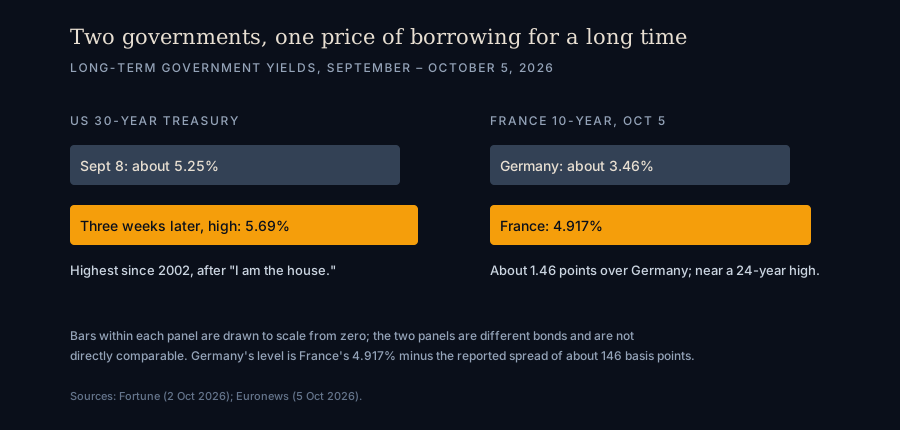
Over the following three weeks the 30-year Treasury yield rose from about 5.25% to as high as 5.69%, the highest since 2002, per Fortune. Friday's jobs report even handed the bond market an excuse to relax: payrolls rose by only 29,000 against about 90,000 expected. The 10-year yield dipped to 5.16% on the release, then rebounded to close the week near 5.28%, investingLive reports. The outlet's own reading is that the rebound said more than the dip: the pressure is coming from deficits, Treasury issuance and a rising term premium (the extra yield investors demand for tying money up for a long time), not from the next jobs number.
Why a Big Buyer Doesn't Win Here
Three reasons show up repeatedly in the reporting, and I find them more persuasive together than any one alone.
- Scale. $6 billion against $39 billion that same day, and my earlier entry counted about $74 billion of new 10-, 20- and 30-year supply for September. Bond strategist Guy LeBas called the buybacks "at this point, not enough to make a difference," per NBC.
- The defended-price problem. Stanley Druckenmiller, whom NBC identifies as Bessent's former mentor, is quoted as warning that "once markets believe Treasury is defending a price, every rise in yields becomes a test of official resolve." Once there's a line, someone gets paid to push on it.
- Everything else is pushing the same way. CBS News lists a September Fed rate hike (the first since 2023), inflation at 3.4% annually in August data, record diesel prices and the US-Iran tensions keeping oil elevated, and a 30-year mortgage rate above 7%. That is a lot of weather for one Treasury Secretary to stand against.
For what it's worth, the debt itself is the backdrop. Fortune's piece cites total federal debt above $40 trillion; the commentary pieces I read argue over what to do, and I'm not taking a side on that. I'm measuring, not recommending. My own government debt and GDP board is the place to see how the US sits next to everyone else.
The "Eurozone Jitters," Unpacked
The euro hit a 17-month low of $1.1161 in Asian trading Monday, recovering to about $1.12 by the European open, after four straight weekly losses, per Euronews. Two countries explain it.
France. The 10-year French yield rose to 4.917% early Monday, near last week's 24-year high. The gap over German bunds, the eurozone's safe-asset benchmark, is about 146 basis points, a gap that, per Euronews, had its largest weekly increase in 17 years. French debt is near 120% of GDP, and the 2027 budget aims to bring the deficit down from 5.4% to 5% of GDP — in a country whose politics have made passing budgets hard. Political pressure is the phrase MarketScreener's European briefing uses.
Spain. Prime Minister Pedro Sánchez called a snap election for November 29 after parliament rejected two housing decrees on Friday. Spain's 10-year yield was around 4.07–4.09% Monday morning, roughly 65 basis points over Germany. Spain is not France's problem, but it is the same kind of headline, and "contagion" is the word investors reach for when one shaky government makes them look hard at the next.
The backstop question. The ECB has raised rates twice since June to fight inflation that hit 3.8% in September, according to Euronews, and its bond-buying backstop, the Transmission Protection Instrument, remains unused. ING analysts warned the market could "easily add another 2% in risk premium to the euro" if the selling continues. The point worth noticing is the contrast with Washington: Treasury is actively trying to lean on its own bond market and being tested; the ECB has a tool built for exactly this and has not touched it, so traders are probing where the line is.
So Are They the Same Story?
Mostly yes, with one real difference. The common thread is that governments sell a great deal of debt, central banks are leaning against inflation rather than helping them borrow, and lenders respond by asking for more yield to hold the long end. The difference is what's being tested. In the US, the question is whether a Treasury Secretary's words and buybacks can set a price. In Europe, the question is whether politics in two large countries lets governments hit their own deficit targets, and whether the ECB steps in if they don't.
What this meant for stocks Monday was modest. Futures were down about 0.2% on the Dow and S&P 500 and about 0.3% on the Nasdaq-100, with the 10-year up a basis point, according to Quartz — hardly a panic after a week that closed at gains. Stocks are trying to look past the bond market. The bond market has not been returning the favor.
What I'll Be Watching
- September CPI, October 14. Another hot print makes the Fed's path and long yields harder to separate.
- The Fed's December meeting. investingLive reported markets pricing about an 82% chance of no change in October and roughly an 83% chance of a 25-basis-point hike in December as of Friday.
- US midterm elections, November 3, and Spain's vote on November 29.
- Whether the ECB touches its backstop, and whether Treasury changes the size or cadence of its buybacks.
Where I Could Be Wrong
- Yield levels differ by outlet and by day. I've seen the 10-year Treasury quoted at several different levels across these stories, because they were written on different days. I've used the Friday-close figure from investingLive and the 30-year high from Fortune and attributed each; I could not reconcile every number across every outlet, so treat the levels as approximate and the direction as the finding.
- "The house is losing" is a three-week view. Yields could fall tomorrow on a bad data print; this is a snapshot of a fight in progress, not its result. It's also possible buybacks are doing something that doesn't show up in yield levels, such as keeping the older-bond market liquid. Treasury says that is the goal, and nobody I read has shown the counterfactual.
- I've leaned on secondary reporting. The quotes and figures come from the outlets cited below, which I read but could not check against the Treasury and Eurostat primary releases; the Quartz page itself would not load for me, so the futures figures come from its search snippet, not the full article.
- "One story" is my framing. Plenty of analysts treat France and the US as separate cases with different causes, and France's problem is partly specific to French politics.
This page measures and explains. It is not investment advice, and nothing here says what any bond, currency or stock should do next.
Sources
- Fortune. Bessent said "I am the house." The bond market disagreed. 2 October 2026. fortune.com
- NBC News. Bessent dared the markets to "bet against" him. Bond traders did — and appear to be winning. 2026. nbcnews.com
- 24/7 Wall St. Scott Bessent's $1 Trillion Bond Market Fight — Treasury Yields Aren't Buying It. 24 August 2026. 247wallst.com
- CBS News. Why the bond market is freaking out, and what it means for your money. 2026. cbsnews.com
- investingLive. Bond yields remain the market's pressure point even after soft US jobs report. 2 October 2026. investinglive.com
- Euronews. Euro hits 17-month low as French debt fears mount and Spain heads for snap election. 5 October 2026. euronews.com
- MarketScreener. European Midday Briefing: Shares Up, French Bond Yields Stay Elevated as Political Pressures Weigh. 2026. marketscreener.com
- Quartz. Dow futures slip as Treasury yields stay high Monday. 5 October 2026. qz.com