Aramco's CEO Says Under 6 Billion Barrels Remain. Under 6 Billion of What?
OCTOBER 6, 2026
On Monday a post quoting Aramco's chief executive, Amin Nasser, went around: "Less than 6 billion barrels remain from global commercial inventories, and most of it is practically unavailable." Under it sat a second claim, that a JPMorgan research line said that when inventories hit 6.8 billion barrels "the global energy system doesn't slow down. It breaks." Put side by side, six is below 6.8, and the implication writes itself. I went to find out whether the quote is real, whether the two numbers are the same kind of number, and what Nasser was actually warning about.
The Quote Is Real
Speaking at the Energy Intelligence Forum in London, Nasser said that "less than six billion barrels of commercial inventories remain today, with the vast majority not practically available." He called the world's stockpiles "scarily thin," and said the seven-month war had cut supply from the region by "nearly three billion barrels." More than one billion barrels, he said, had been drawn from reserves to cushion that, and "replenishing inventories while meeting demand could take up to two years." In August he had put the rebuild at up to 18 months, so the estimate has lengthened.
Why 6 and 6.8 Are Not Comparable
JPMorgan's commodities research head, Natasha Kaneva, did publish "operational minimum" estimates this spring, and they are the source of the viral line. But the pieces of her work I could read use different yardsticks:
- One account defines the minimum for OECD commercial crude only, at roughly 842 million barrels, about 30 days of forward refining throughput.
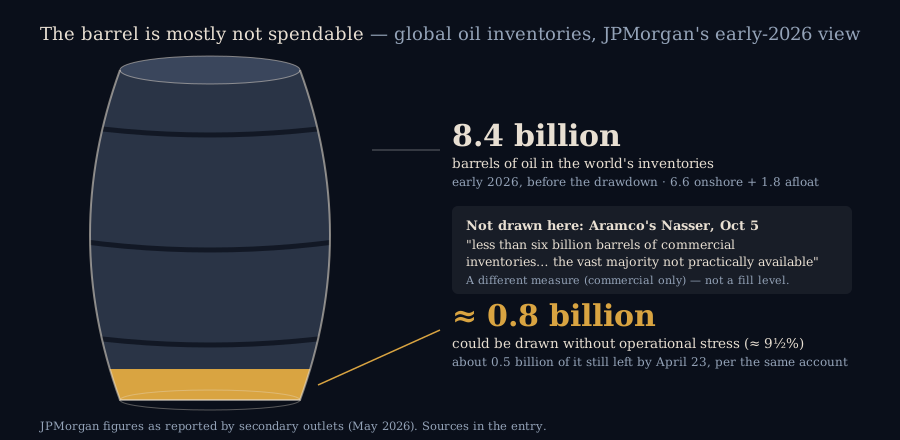
- Another puts total global inventories at about 8.4 billion barrels at the start of the year (6.6 billion onshore, 1.8 billion afloat), of which only about 800 million could be drawn without operational stress.
- The 6.8 billion figure appears in secondary reports as a global "operational floor." I could not find which exact measure it uses, and the two accounts I read don't contain it.
Nasser's number is commercial inventories: the stocks held by companies, as distinct from government strategic reserves or oil on tankers. A commercial-only figure can legitimately sit below a global total that includes everything, so "six is less than 6.8" doesn't show a floor was crossed. It shows two numbers that were never on the same ruler. I would not claim the world is below JPMorgan's line, or above it, on this evidence.
What He Was Actually Warning About
The part of the speech that is hardest to wave away is not the headline total. It is the last clause: most of that inventory is "not practically available." Oil sitting in a pipeline, a terminal or a refinery's working tanks is not a reserve anyone can spend. That is the same idea as JPMorgan's 800 million usable barrels out of 8.4 billion, which is the number the debate should be about: how much can be drawn, not how much exists.
The second thing is the pace. Nasser's two-year rebuild assumes the strait reopens and demand is met at the same time. He also noted that physical North Sea crude for current-month delivery was at its highest since April, which fits the freight spike and tight physical market I wrote about earlier this week.
A Wrinkle in the Hormuz Story
The same coverage reports that shipments from Gulf countries recently reached 15.5 million barrels a day, the highest since the conflict began and over 80% of pre-war volume, at much higher cost. That doesn't match a picture of a fully closed strait, and some of my own earlier posts leaned on that picture. The accurate version looks to be a strait that is open but constrained and expensive, with the shortfall being absorbed by inventories. I'll keep that in mind when I describe it.
What I'll Be Watching
- Whether the IEA and EIA monthly reports show commercial stocks consistent with Nasser's figure, and on which definition.
- Whether anyone publishes the "usable" inventory number, which matters more than the total.
- Whether Gulf flows hold above 15 million barrels a day.
Where I Could Be Wrong
I read Nasser's remarks through press accounts, not a transcript, and the Business Standard article carrying a "less than 10 percent available" angle was blocked to me, so I have not repeated that claim. The JPMorgan accounts are secondary and partly inconsistent about definitions, which is the reason I haven't claimed a crossing either way. I did not find a reliable current Brent price, so none is quoted. Nothing here is a trading view.
Sources
- The Irish Times. Saudi Aramco boss warns world's oil stockpiles are 'scarily thin'. 5 October 2026. irishtimes.com
- Baird Maritime. Aramco warns global oil inventories running low as it posts $33b profit. August 2026. bairdmaritime.com
- Investing.com. How Close Is Crude Oil to Its Operational Minimum? JPMorgan Estimates. 2026. investing.com
- BigGo Finance. JPMorgan Warns: Global Crude Oil Inventories May Hit "Operational Minimum"… 1–2 May 2026. finance.biggo.com
- bne IntelliNews. World oil inventories falling fast towards hard operational floor. 2026 (cited for the 6.8 billion figure; I could not open the article text). intellinews.com
- Qasem Al-Ali (@AlaliQasem). Post quoting Nasser. 5 October 2026. x.com