CME Dropped 24/7 Oil Trading. "Staffing" Is the Smallest Reason.
OCTOBER 6, 2026
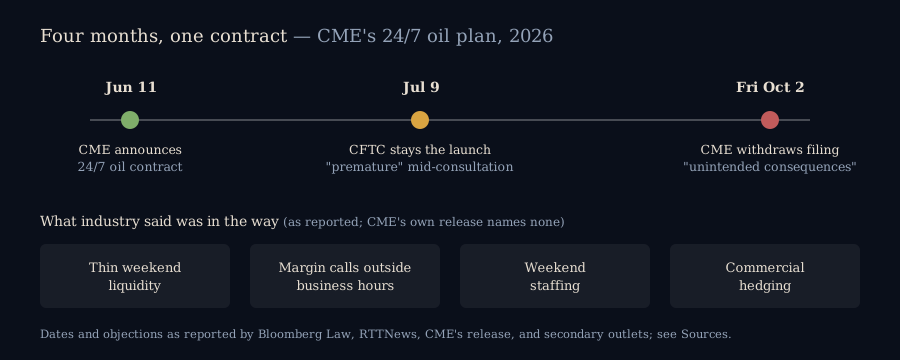
A post making the rounds Monday said CME Group "dropped plans for 24/7 oil trading over concerns about… staffing," and that it was announced at 5pm on a Friday in the hope nobody would notice. The Friday part is right. The staffing part is a joke that has swallowed the story, and the real one is more interesting, because it is about what happens when you try to run a benchmark oil price around the clock in a month when physical oil is already under strain.
What CME Actually Said
On Friday, October 2, CME Group withdrew its filing for a 10-barrel crude oil futures contract built for 24/7 trading. Chairman and CEO Terry Duffy's stated reason was that "after extensive discussions with industry participants," key constituents were concerned that launching 24/7 energy trading "without further due diligence could create unintended consequences and add risk to the market." As the release is quoted in the coverage I could read, it does not mention staffing at all.
Duffy's release also did not retreat on the underlying argument. CME's position is that 24/7 oil already exists offshore in perpetual contracts, and that US retail traders reach it anyway, sometimes through VPNs, so a regulated US version is the safer option. He asked the CFTC to "reestablish the level playing field." This is a pause in a fight, not a surrender.
The Part the Joke Skips
The contract was not on a path to launch quietly. CME announced it on June 11. On July 9, with trading possible as soon as the next day, the CFTC blocked it: Chairman Michael Selig said that self-certifying the contract while the agency's own public consultation on 24/7 futures was still open was "premature," and the Commission opened a fuller review. So by Friday, CME had been stuck for almost three months, and the withdrawal reads less like a surprise than like a company stepping out of a process it was losing.
Why Industry Pushed Back
Secondary outlets summarizing the CFTC comment record report the same cluster of objections, and I'd weigh them as reports, not as CME's own words:
- Thin weekend liquidity. Fewer commercial hedgers and market makers means wider spreads and a greater chance that a weekend print on WTI, a global benchmark, reflects a thin book instead of real supply and demand.
- Margin and collateral. A futures position can be margin-called at any hour once the market never closes, when corporate treasury and risk teams are least able to move cash.
- Commercial hedging. The American Petroleum Institute and BP were reported to have told the CFTC that round-the-clock operation would complicate hedging and push margin demands outside normal hours.
- Staffing. API was reported to have said continuous trading would "strain weekend staffing." That is the whole origin of the joke. It is a real objection, but it is one item on a list, and it is a sort of shorthand for "the whole surrounding system, from clearing to risk to treasury, is built around a weekend."
Why It Lands in a Month Like This
The same week, a freight report put the cost of moving 2 million barrels of crude from West Africa to China at $27.22 a barrel against about $6.50 in July (the figure is the Kobeissi Letter's, and I haven't confirmed it). Take that at face value and the physical market is scrambling. A benchmark that prices that scramble through a weekend, in a book thin enough to move on a single order, is exactly what the objectors were worried about. It is also what the proponents would say they need, since offshore perpetuals already trade it. Both readings are defensible, and I don't think this story settles which one is right.
What I'll Be Watching
- Whether the CFTC finishes its 24/7 consultation, and what rules it proposes. That, not CME's filing, is the decision that matters.
- Whether CME resubmits, or whether offshore perpetual oil contracts keep growing in the meantime.
- Whether weekend gaps in WTI itself widen if the physical squeeze continues.
Where I Could Be Wrong
I could not read the full CME release or the CFTC comment letters directly. The objections above come from secondary summaries that agree with each other but may be compressing the originals, and the sources disagree on small details: one describes the contract as one-tenth the size of Micro WTI, another as 10 barrels. I've used only the 10-barrel figure from CME's own headline. The Friday time of day also varies by report, so I haven't repeated "5pm." Nothing here is a trading view; it is a read of how a market's plumbing got argued over.
Sources
- CME Group. CME Group Withdraws Filing for 24/7 10-Barrel Crude Oil Futures. 2 October 2026 (as republished by StockTitan). stocktitan.net
- BOE Report. CME Group withdraws filing for 24/7 10-barrel crude oil futures contract. 2 October 2026. boereport.com
- RTTNews. CFTC halts CME's planned 24/7 crude oil futures trading. 9 July 2026. rttnews.com
- Bloomberg Law. CFTC Blocks for Now CME's Plan to Offer 24/7 Oil Futures. July 2026. bloomberglaw.com
- Bloomingbit. CME Group Drops 24-Hour Crude Futures Plan After Industry Backlash. 2 October 2026 (industry objections, as summarized). bloomingbit.io
- Phemex. Why CME Paused 24/7 WTI Futures. October 2026 (objections, as summarized). phemex.com
- Matthew Sigel (@matthew_sigel). Post on the withdrawal. 5 October 2026. x.com
- The Kobeissi Letter (@KobeissiLetter). Post on West Africa–China crude freight. 5 October 2026. x.com