Bitcoin Didn't Start in 2008
OCTOBER 5, 2026
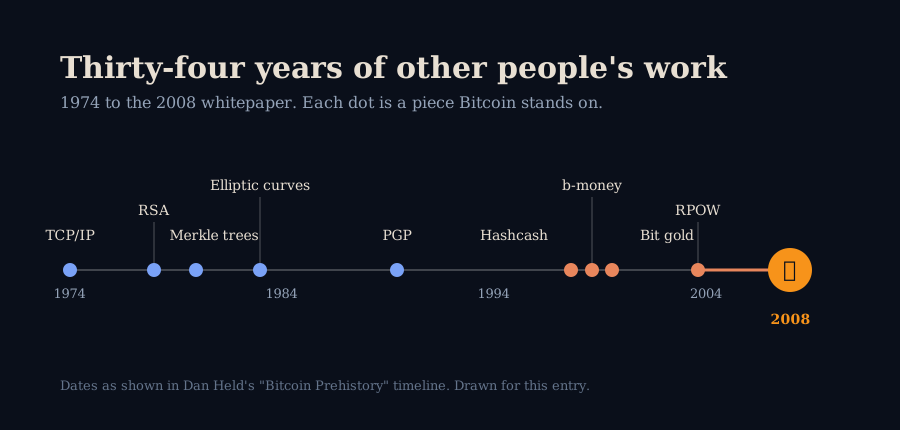
The usual telling of Bitcoin's origin has the shape of a magic trick. Nobody, then a pseudonym, then a whitepaper on October 31, 2008, then money. It makes a good story and a lousy history, because almost nothing in the paper was new. What was new was the arrangement: someone took a dozen ideas that had been sitting in different drawers for thirty years and found that they locked together.
I've been looking for a way to show that, and a two-minute screen recording does it better than I can in prose. It walks through twenty-seven of the pieces, one card per year, from the protocol the internet runs on to the proof-of-work chains that came right before. It is based on the "Bitcoin Prehistory" timeline by Dan Held, who has been making the case for years that Bitcoin's prehistory is forty years of research and demand, not one person's afternoon. Headphones are optional, and the clip has a soundtrack.
The Stack, in Four Layers
Watch it once for the feel and a second time sorted into layers, because the cards fall into four groups, and Bitcoin needs all four.
The plumbing. 1974: Vint Cerf and Bob Kahn publish the protocol that becomes TCP/IP. Bitcoin is a network before it is anything else, and it runs on the open one that already existed. Nobody had to ask anybody for the road.
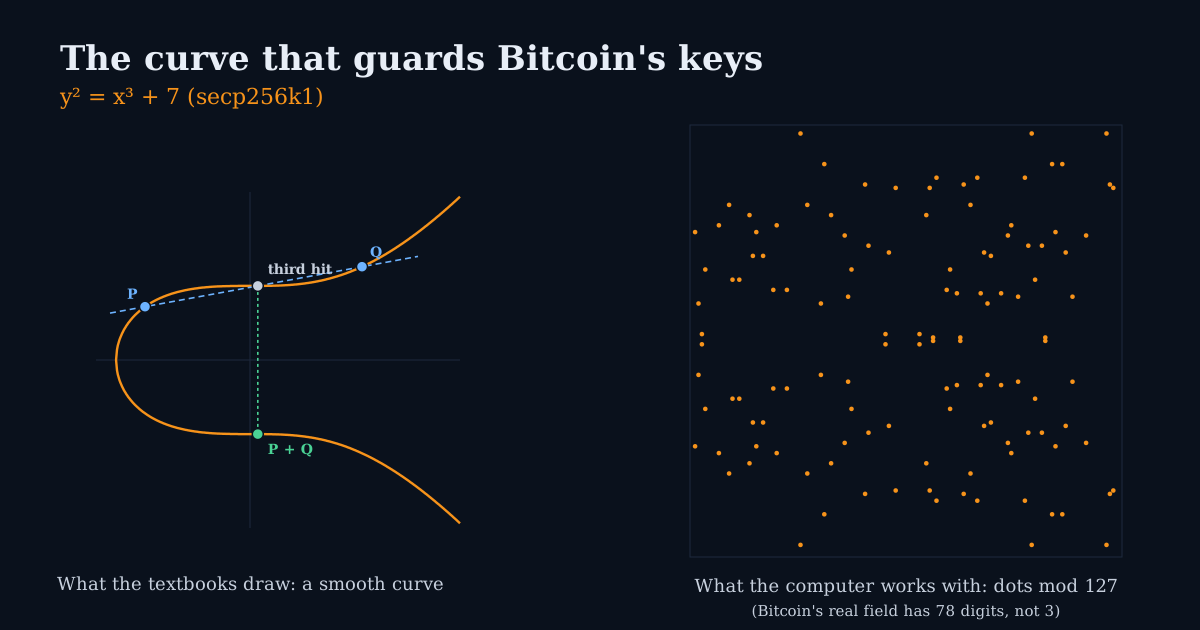
The math that makes a coin a signature. 1978 gives you RSA and digital signatures, which is why a Bitcoin transaction can be proven to come from whoever holds the key. 1980 gives you Ralph Merkle's hash trees, which is how a block summarizes thousands of transactions in one short fingerprint. 1985 gives you elliptic curve cryptography, which is why the keys are short and the signatures are strong. The curve Bitcoin signs on, secp256k1, is on the card. (Yes, the formula in the video really is that small. Seven is the entire "plus b".)
The why. This layer is not math, which is what makes it the one people skip. 1988: Timothy May's Crypto Anarchist Manifesto. 1991: Phil Zimmermann's PGP, strong encryption for anyone. 1993: Eric Hughes writes that cypherpunks write code. The consistent idea across all three is that cryptography is a way to move power toward individuals, and that the answer to asking permission is to build the thing instead. If you've wondered why Bitcoin people sound like they're in a political movement, it's because the movement came first and the coin came second.
The money attempts. This is the layer that most resembles Bitcoin, and also the one that failed the most. 1996: e-gold, which was digital gold run by one company in the middle. 1999: Max Keiser's virtual securities market. 2006: Liberty Reserve, another single point of failure, shut down in 2013. The card on that last one is stamped SHUT DOWN, and it's the cleanest summary in the whole video: every digital cash scheme before Bitcoin had a company in the middle, and every one of them had the same off switch.
Against that, the proof-of-work cards are where it starts to look like the finished article. 1997: Adam Back's Hashcash, a way to make spam expensive by making the sender burn a measurable amount of computing. 1998: Wei Dai's b-money, with money created by work and a ledger kept by everyone. 1998: Nick Szabo's Bit gold, which chains each proof into the next challenge. 2004: Hal Finney's reusable proof of work, a server that can hand a "token" along to the next person. Put those four side by side and Bitcoin starts to read less like an invention and more like an editor's cut.
The Card That Settles It
The last real card in the video is the best one, because it's not a claim from the video. It's the whitepaper's own reference list, the page where Satoshi had to say who he was standing on. There are eight entries. Three of them are on the video's timeline, and the video highlights them: Wei Dai's b-money from 1998, Adam Back's Hashcash from 1997, and Merkle's 1980 hash-tree paper. Each is cited by name, in a paper that otherwise has the confidence of someone describing a solved problem.
That is a more interesting fact than "he copied". The paper does not cite the manifestos, or PGP, or Bit gold, or e-gold, and no one reading the reference list alone would guess at the thirty years behind it. The ones he names are the load-bearing parts. The rest is the air in the room.
What I Take From It
The prehistory is evidence of a particular kind, and it's worth saying which kind. It does not show that Bitcoin will work, or that it's worth any price. What it shows is that the parts are old and individually well-tested: signatures, hash trees, elliptic curves and proof of work were each doing real jobs for decades before anyone wrote the word "blockchain" down. The only genuinely new claim in 2008 was that you could remove the company from the middle without the whole thing falling over, and the shutdown cards on the video are the argument for why that was worth trying.
It is also a reminder for anyone tempted to think Bitcoin had a founder who simply invented it. Satoshi did something real and hard, which was to assemble the pieces and make them agree. But if that story is told without Cerf, Merkle, May, Zimmermann, Back, Dai, Szabo and Finney, it's missing most of its cast.
A caveat on the video itself: it's a timeline, which means it's a selection. Twenty-seven cards is somebody's judgment about what mattered, and a different historian would drop some and add others. Treat it as a map of the neighborhood, not a verdict on who deserves the credit.
The live numbers for where all this ended up are on the Ledger's Bitcoin Board. The video is the other end of the same chart: what went into it before it had a price.